
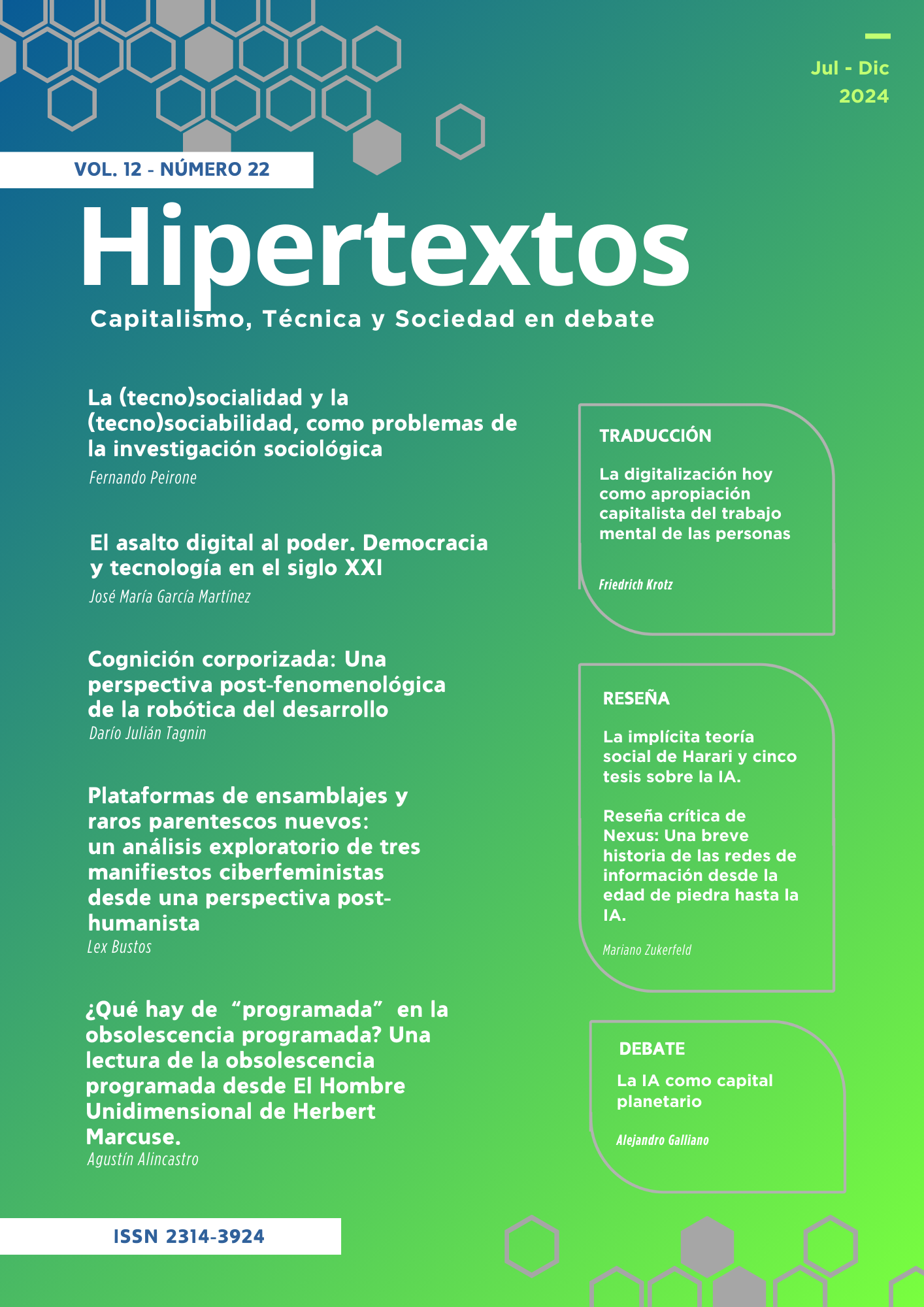
Plataformas de ensamblajes y raros parentescos nuevos
Un análisis exploratorio de tres manifiestos ciberfeministas desde una perspectiva post-humanista
DOI:
https://doi.org/10.24215/23143924e092Palabras clave:
Ciberfeminismo, transfeminismo, manifiestos políticos, post-humanismo, trans-humanismoResumen
¿Cómo se vinculan las conversaciones sobre ciberfeminismo y transfeminismo, y qué aportaron al pensamiento crítico, en general, y al feminismo especulativo, en particular?
Se analizan los puentes conceptuales entre tres manifiestos políticos ciberfeministas que resultan claves y fueron originados en momentos muy distintos de la era digital: el Manifiesto para Cyborgs, de Donna Haraway (de 1985); el Manifiesto Contrasexual, de Paul B. Preciado (de 2000); y el Manifiesto Xenofeminista, del colectivo Laboria Cuboniks (de 2015).
Se analizan cuatro dimensiones: i) tecnología y estrategias para su refuncionalización/reapropiación social; ii) cuerpo y sus ensamblajes; iii) parentesco y alianzas políticas; y iv) feminismo y revolución.
Se plantean cuatro hipótesis exploratorias: 1) En virtud de que los manifiestos resultan hitos en una genealogía del ciberfeminismo y del transfeminismo, presentan una especial riqueza epistémica en clave interseccional por su potencial para desmantelar la matriz de pensamiento binario; 2) Cada manifiesto propone un ensamblaje de categorías hasta entonces estrictamente binarias: entre humano y máquina; entre naturaleza y tecnología; y entre lo local y lo global; y 3) Cada manifiesto despliega una estrategia de reapropiación/refuncionalización tecnosocial de ciertas tecnologías cibernéticas, las cuales resultan críticas tanto por su funcionalidad técnica como por su espectralidad política: respectivamente, el cyborg, el dúo dildo/prótesis, y el trío plataforma/protocolo/meme; y 4) En tanto estas tecnologías en cada manifiesto son descriptos como sistemas sociotécnicos complejos y a la vez estilizados como mitos tecnofeministas que fusionan teoría y praxis, sus usos disidentes y estratégicos suponen prácticas epistémicas y políticas rebeldes que nutren un pensamiento especulativo en clave feminista.
Referencias
Balcarce, G. (2023). Post-humanismo espectral. La Cebra.
Berti, A. (2023). Nanofundios: crítica de la cultura algorítimica, La Cebra.
Bidaseca, K., Lodwick Núñez, L. y Guimaraes Costa, M. (Coords.). (2022). Donna Haraway: cyberancestra. Elmismomar.
Braidotti, R. (2015). Lo Posthumano. Gedisa.
Braidotti, R. (2020). Conocimiento post-humanista. Gedisa.
Braidotti, R. (2022). Feminismo post-humanista. Gedisa.
Butler, J. (2018). Cuerpos que importan, Paidós.
Butler, J. (2018). Deshacer el género. Paidós.
Crenshaw, K. (1989). Demarginalizing the Intersection of Race and Sex: A Black Feminist Critique of Antidiscrimination Doctrine, Feminist Theory and Antiracist Politics. University of Chicago Legal Forum, (8).
Deleuze, G. (1999). Post-Scriptum a las sociedades de control. En Conversaciones: 1972-1990. Pre-textos.
Der Derian, J. (1991). On Diplomacy. Blackwell.
Felizi, N. y Zaragoza Cano, L. (2018). Manifiesto por Algoritmias Hackfeministas. En R. Zafra y T. López-Pellisa (Eds.), Ciberfeminismo: De VNS Matrix a Laboria Cuboniks. Holobionte.
Fraser, L. (6 de febrero de 2017). Xenofeminism and new tactics for the left, entrevista de Merray Gerges. Canadian Art. https://canadianart.ca/interviews/xenofeminism/
Geertz, C. (2003). La interpretación de las culturas. Gedisa.
Haraway, D. (2016). Manifiesto de las especies de compañía. Sans Soleil Ediciones.
Haraway, D. (2018). Manifiesto para Cyborgs: Ciencia, tecnología y feminismo socialista a finales del siglo XX. Letra Sudaca.
Haraway, D.(2019). Seguir con el problema: generar parentesco en el Chthuluceno, Walhuter.
Hester, H. (2019). Xenofeminismo: tecnologías de género y políticas de reproducción. Caja Negra.
Hooks, B. (2020). Teoría feminista: de los márgenes al centro. Traficantes de sueños.
Hui, Y. (2022). Recursividad y contingencia. Caja Negra.
Laboria Cuboniks. (2015). Xenofeminismo: Una política por la alienación. https://laboriacuboniks.net/manifesto/xenofeminismo-una-politica-por-la-alienacion/
Laboria Cuboniks. (2022). Nuevos vectores del xenofeeminismo. Holobionte.
Lukacs de Pereny, M. (2023). Neo entes: tecnología y cambio antropológico en el siglo 21. Grupo Unión.
Parente, D., Berti, A. y Celis, C. (Coords.). (2022). Glosario de filosofía de la técnica. La Cebra.
Preciado, P. B. (2020). Manifiesto Contrasexual.Anagrama.
Preciado, P. B. (2022). Dysphoria mundo. Anagrama.
Russel, L. (2012). Digital Dualism and The Glitch Feminism Manifesto. https://thesocietypages.org/cyborgology/2012/12/10/digital-dualism-and-the-glitch-feminism-manifesto/
Stone, S. (2020). La guerra de deseo y tecnología (y otras historias de sexo, muerte y máquinas). Holobionte.
Syms, M. (2013). El Manifiesto Afrofuturista Mundano. En R. Zafra y T. López-Pellisa (Eds.), Ciberfeminismo: de VNS Matrix a Laboria Cuboniks. Holobionte.
Turkle, S. (2020). En defensa de la conversación: el poder de la conversación en la era digital. Ático de los Libros.
Zafra, R. y López-Pellisa, T. (Eds.). (2019). Ciberfeminismo: De VNS Matrix a Laboria Cuboniks, Holobionte.
Descargas
Publicado
Número
Sección
Licencia
Derechos de autor 2024 Lex Bustos

Esta obra está bajo una licencia internacional Creative Commons Atribución-NoComercial-SinDerivadas 4.0.