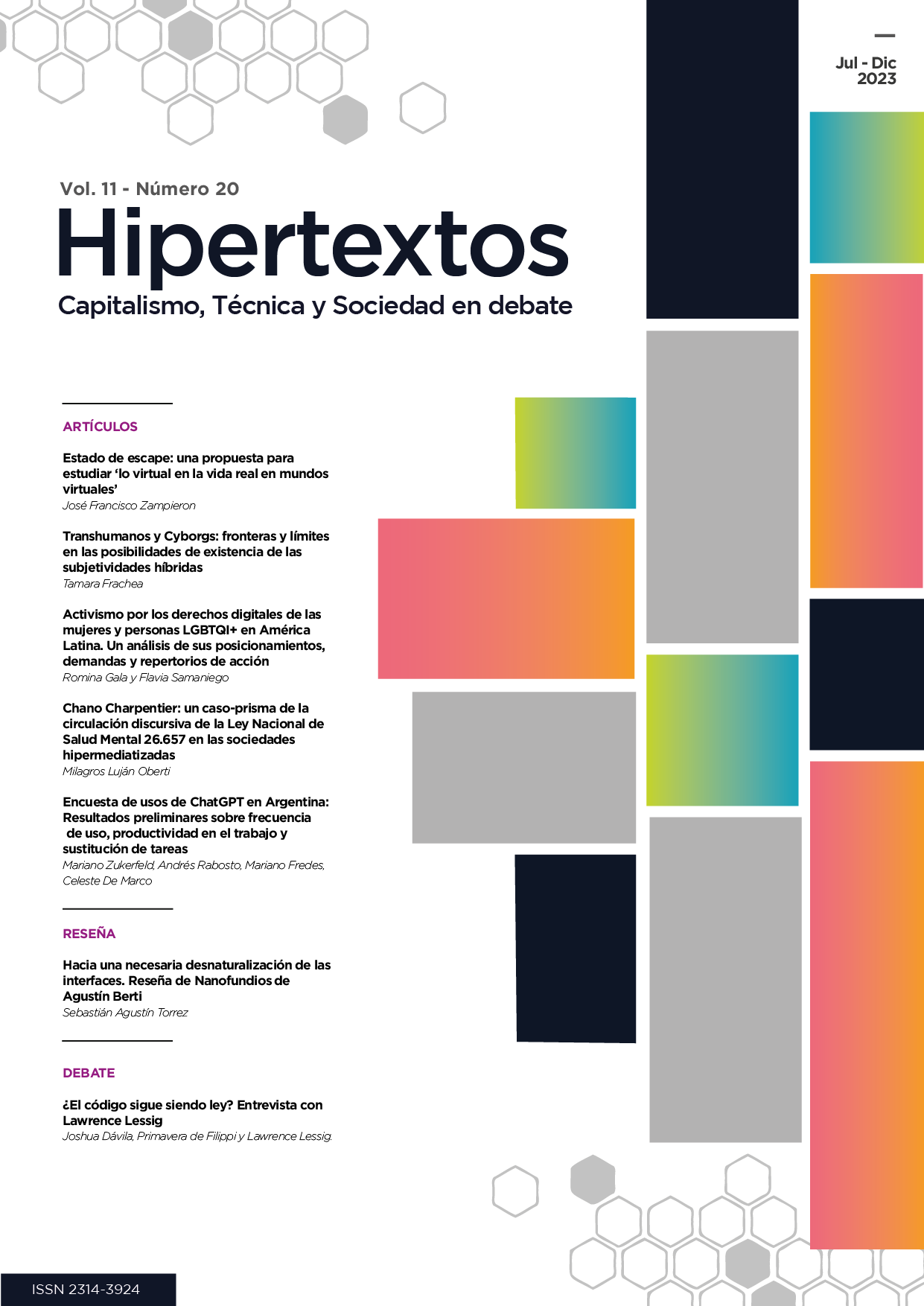
Survey of ChatGPT uses in Argentina
Preliminary results on frequency of use, productivity at work and task substitution.
DOI:
https://doi.org/10.24215/23143924e075Keywords:
encuesta, trabajo, productividad, automatización, chatGPTAbstract
Since the spread of ChatGPT, discussions about the impacts of generative artificial intelligence (GAI) have become widespread. In Argentina, such debates have been developed by importing analytical frameworks and without empirical support. Therefore, this article seeks to disseminate partial results of an ongoing survey on the use of ChatGPT in Argentina. Theoretically, the article starts from understanding that GAI is part of the platform phase of digital capitalism, where the trend towards platformization and the digital automation of work prevail, and where the capital accumulation model of profit from openness stands out. ChatGPT represents both trends. The main findings presented here indicate a high penetration of ChatGPT in productive areas: 75% of those who have used it at least once claim to use it for work tasks. More relevantly, 85% of those who have used it believe they achieve hourly productivity gains. However, 60% believe that their job will not be automated in the future. Thus, the data suggests that the priority is not so much on the challenges of full substitution, but on those imposed by complementarity and the distribution of productivity gains.
References
Acemoglu, D. y Autor, D. (2011). Skills, tasks and technologies: Implications for employment and earnings. Handbook of labor economics, 4, 1043-1171.
Alvarado Retamal, E. C. y Veramendi, M. (2023). Significaciones de los jóvenes sanjuaninos en torno a las nuevas modalidades de trabajo. 9° Encuentro de Investigadores de Ciencias Sociales región Centro Oeste (InReCo) 6° Binacional con la IV Región de la República de Chile [Ponencia].
Autor, D., Levy, F. y Murnane, R. J. (2003). The skill content of recent technological change: An empirical exploration. The Quarterly journal of economics, 118(4), 1279-1333.
Autor, D. (2013). The task approach to labor markets: an overview. Journal Labour Mark Res 46(3),185–199.
Autor, D. (2014). Polanyi’s Paradox and the Shape of Employment Growth. Working Paper w20485, National Bureau of Economic Research.
Autor, D., Katz, L. y Krueger, A. (1998). Computing Inequality: Have Computers Changed the Labor Market. The Quarterly Journal of Economics, 113 (4), 1169-1213.
Arntz, M., Gregory, T. y Zierahn, U. (2016). The risk of automation for jobs in OECD countries: a comparative analysis. OECD Social, Employment, and Migration Working Papers, 189.
Basco, A. y Lavena, C. (2019). Un potencial con barreras: la participación de las mujeres en el área deficiencia y tecnología en Argentina. BID.
Baum, G., Lepratte, L., Yoguel, G. y Cahais, H. (2023). Los procesos de co-producción y emergencia de innovaciones en Grandes Sistemas Informáticos del sector público: el caso e-Sidif. CIECTI.
Blondeau, O., Whiteford, N. D., Vercellone, C., Kyrou, A., Corsani, A., Rullani, E., Boutang, M. y Lazzarato, M. (2004). Capitalismo cognitivo, propiedad intelectual y creación colectiva. Traficantes de sueños.
Brynjolfsson, E., Li, D. y Raymond, L. R. (2023). Generative AI at work (No. w31161). National Bureau of Economic Research.
Brynjolfsson, E. y Mitchell, T. (2017). What Can Machine Learning, Do? Workforce Implications. Science, 358, 1530-1534.
Castells, M. (2006). La sociedad red: una visión global. La era de la información. Alianza.
Eloundou, T., Manning, S., Mishkin, P. y Rock, D. (2023). Gpts are gpts: An early look at the labor market impact potential of large language models. https://doi.org/10.48550/arXiv.2303.10130
Eisfeldt, A. L., Schubert, G. y Zhang, M. B. (2023). Generative ai and firm values (No. w31222). National Bureau of Economic Research.
Felten, E., Raj, M. y Seamans, R. (2021). Occupational, industry, and geographic exposure to artificial intelligence: A novel dataset and its potential uses. Strategic Management Journal, 42(12), 2195-2217.
Felten, E., Raj, M. y Seamans, R. (2023). How will Language Modelers like ChatGPT Affect Occupations and Industries?. General Economics. https://doi.org/10.48550/arXiv.2303.01157
Franco, S. F., Graña, J. M., Rikap, C. y Robert, V. (2022). Industria 4.0 como sistema tecnológico. Argentina Productiva 2023, Documento Nro 37. Ministerio de Economía Secretaría de industria y desarrollo productivo.
Frey, C.B. y Osborne, M.A. (2013). The future of employment: How susceptible are jobs to computerisation?. Technol Forecast Soc Change, 114, 254–280.
Guitart, V., Rabosto, A. y Segal, N. (2022). Brechas de género en el sector de software en Argentina. Integración y Comercio, (48), 125-167.
Lund, A. y Zukerfeld, M. (2020). Corporate Capitalism's Use of Openness: Profit for Free? Springer Nature.
Noy, S. y Zhang, W. (2023). Experimental evidence on the productivity effects of generative artificial intelligence. SSRN 4375283. http://dx.doi.org/10.2139/ssrn.4375283
Palermo, H. M., Radetich, N. y Reygadas, L. (2020). Trabajo mediado por tecnologías digitales: sentidos del trabajo, nuevas formas de control y trabajadores ciborg. Revista Latinoamericana de Antropología del Trabajo, 4 (7), 1-35.
Pawel, G., Janine, B. y David, B. (2023). Generative AI and jobs a global analysis of potential effects on job quantity and quality. International Labour Organization.
Peng, S., Eirini K., Peter C. y Mert, D. (2023). The Impact of AI on Developer Productivity: Evidence from GitHub Copilot. Software Engineering. https://doi.org/10.48550/arXiv.2302.06590
Rabosto, A. (2023). El ChatGPT y la última milla del humanismo. Revista Nuso. https://nuso.org/articulo/chat-gpt-inteligencia-artificial-capitalismo-humanismo/
Srnicek, N. (2018). Capitalismo de plataformas. Caja Negra.
Yansen, G. (2020). Género y tecnologías digitales: ¿qué factores alejan a las mujeres de la programación y los servicios informáticos?. Teknokultura, 17(2), 239-249.
Yoguel, G., Chanders, V. y Mochi, S. (2021). Innovación por coproducción en industria 4.0: un estudio de caso de inteligencia artificial aplicadas a imágenes médicas. CIECTI.
Zarifhonarvar, A. (2023). Economics of chatgpt: A labor market view on the occupational impact of artificial intelligence. SSRN 4350925. http://dx.doi.org/10.2139/ssrn.4350925
Zukerfeld, M. (2010). Cinco Hipótesis sobre el Trabajo Informacional. Aproximaciones a la caracterización del mundo laboral en el Capitalismo Cognitivo. Revista Electrónica Gestión de las Personas y Tecnología (9), 76-85.
Zukerfeld, M. (2014). Inclusive Appropriation and the Double Freedom of Knowledge: On the Capitalist exploitation of non-for profit software, contents and data producers. Sociologia del Lavoro, 133, 144-158.
Zukerfeld, M. (2020). Bits, plataformas y autómatas: las tendencias del trabajo en el capitalismo informacional. Revista Latinoamericana de Antropología del Trabajo, 4 (7), 1-50.
Downloads
Published
Issue
Section
License

This work is licensed under a Creative Commons Attribution-NonCommercial-NoDerivatives 4.0 International License.