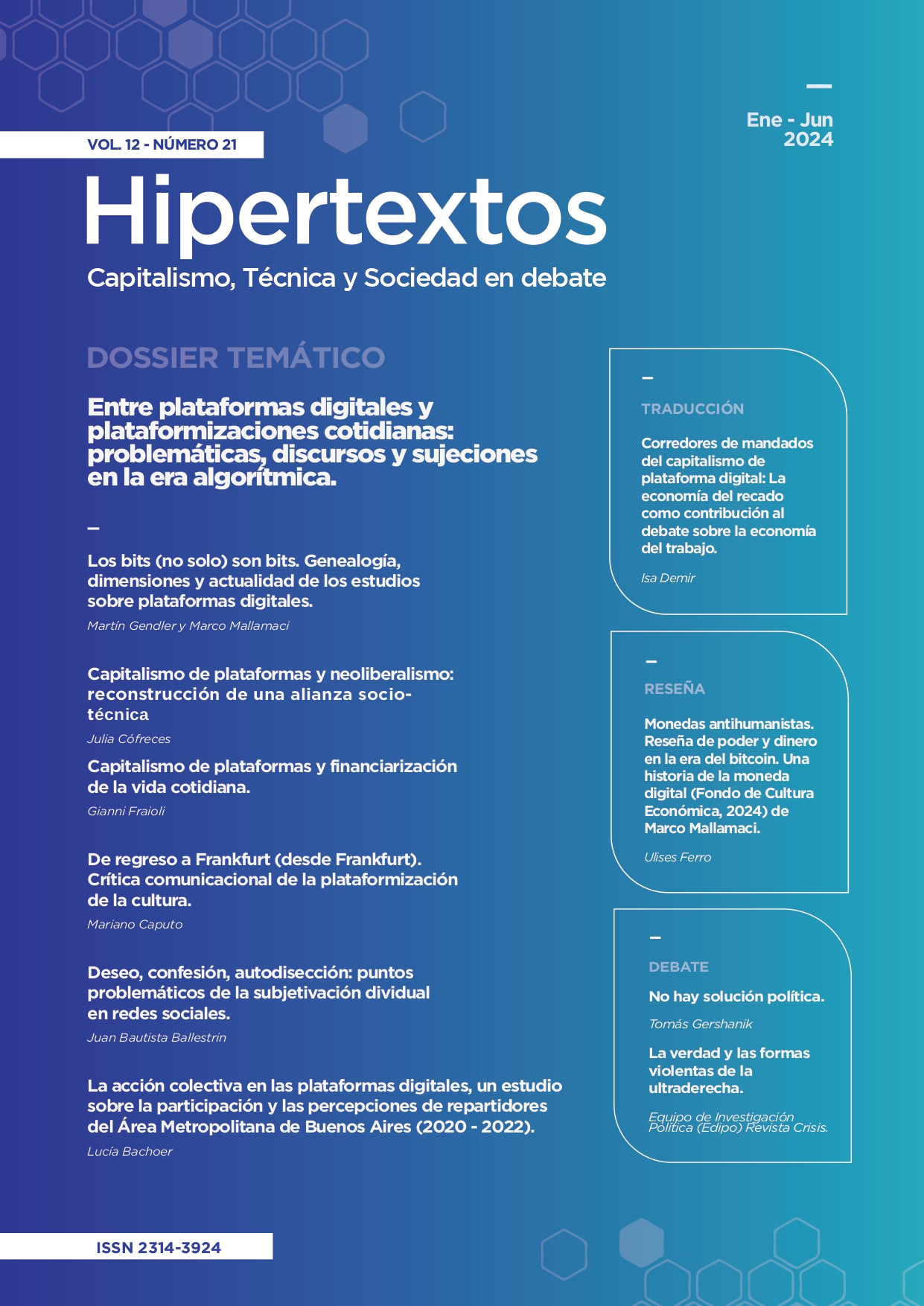
The truth and the violent ways of the far right
DOI:
https://doi.org/10.24215/23143924e086Keywords:
nueva derecha, investigación política, tecnopolítica, activismo digitalAbstract
The article analyses the consolidation of the far-right in Argentina, its political and social impact, and explores possible strategies of resistance to the political violence deployed, both physical and virtual. It explores the situation opened up by the rise of the ultra-right, its capacity to interpret the present moment and particularly the contemporary regime of information circulation. From this analysis, it argues for the need to develop new political research methodologies that combine academic rigour with political activism. Finally, they propose to work on forms of political intervention based on the production of a historical truth, through heterogeneous collaboration and a methodology of citizen resistance, underlining the importance of elaborating long-term strategies to counter the radicalisation of the far-right.
References
Centro de Estudios Legales y Sociales. (2 de abril de 2024). Disputar el sentido de Malvinas como vector del negacionismo oficial. Revista Crisis. https://revistacrisis.com.ar/notas/disputar-el-sentido-de-malvinas-como-vector-del-negacionismo-oficial
Centro de Estudios Legales y Sociales y Equipo de Investigación Política. (2024). Mapa político del gobierno de Javier Milei. Revista Crisis. https://informes.revistacrisis.com.ar/mapa-politico-gobierno-milei/
Centro de Estudios Legales y Sociales y Equipo de Investigación Política. (27 de mayo de 2024). Apuntes sobre Milei y el internacionalismo reaccionario. Revista Crisis. https://revistacrisis.com.ar/notas/apuntes-sobre-milei-y-el-internacionalismo-reaccionario
Centro de Estudios Legales y Sociales y Equipo de Investigación Política. (2024). Capital inhumano: los seis primeros meses del experimento libertario. Revista Crisis. https://informes.revistacrisis.com.ar/capital-inhumano-experimento-libertario/
Centro de Estudios Legales y Sociales y Equipo de Investigación Política. (24 de junio de 2024). La conexión alemana. Revista Crisis. https://revistacrisis.com.ar/notas/la-conexion-alemana
Equipo de Investigación Política. (2023). La violencia avanza. informe a un año del atentado a CFK. Revista Crisis. https://informes.revistacrisis.com.ar/la-violencia-avanza-1s/
Equipo de Investigación Política. (2023). Los dinosaurios no van a desaparecer. Revista Crisis. https://informes.revistacrisis.com.ar/los-dinosaurios-no-van-a-desaparecer/
Forti, S. (marzo-abril de 2022). Posverdad, fake news y extrema derecha contra la democracia. Nueva Sociedad, 298. https://nuso.org/articulo/posverdad-fake-news-extrema-derecha-contra-la-democracia/
Mariátegui, J. C. (2007). Peruanicemos al Perú. Ediciones El Andariego. (Trabajo original publicado en 1924)
Nogués, G. (2019). Pensar con otros: una guía de supervivencia en tiempos de posverdad. ABRE | El gato y la caja.
Petrucelli, A. (3 de marzo de 2023). Crítica de la política y la (sin)razón posmoderna. Agencia Latinoamericana de Información. https://www.alai.info/critica-de-la-politica-y-la-sinrazon-posmodernas/
Riorda, M. (26 de mayo de 2024). El aceleracionismo en la comunicación política: transformación, vértigo y presión. @maRIOrioRDA. https://mario-riorda.beehiiv.com/p/el-aceleracionismo-en-la-comunicacin-poltica-transformacin-vrtigo-y-presin
Serna, J. y Pons, A. (2013). La historia cultural: autores, obras, lugares. Akal.
Downloads
Published
Issue
Section
License

This work is licensed under a Creative Commons Attribution-NonCommercial-NoDerivatives 4.0 International License.