Building strategic autonomy: External outreach and connectivity
India and its ties with Central Asian republics
DOI:
https://doi.org/10.24215/23142766e216Keywords:
India, central Asian republics, strategic autonomy, geopoliticsAbstract
India is the world's fourth-largest economy, and its growth and development depend on energy imports and critical minerals to meet growing domestic demand. Seeking to reduce dependence on such inputs and strengthen its strategic autonomy, it proposes to diversify external sources of supply, deploying active diplomacy and economic policy linking it with the Central Asian Republics (CARs). Based on historical ties, its assessment of long-term benefits, and existing complementarity, it promotes various infrastructure projects that improve regional connectivity and increase interdependence with a geopolitically relevant area that provides strategic resources. Within this framework, this paper addresses India's external strategy in its relations with the CARs, from a qualitative perspective, through a bibliographic and documentary review, concluding that through public-private actions, India claims a strategic space in Central Asia that maximizes its influence and confirms its leadership.
References
Abbas, Z., Kalim, I. y Malik, M. S. (2019). CASA-1000: its potential for regional trade and development. Global Political Review, 4(3), 39-48. http://dx.doi.org/10.31703/gpr.2019(IV-III).05
Acharya, A. (23 de junio de 2023). Connecting South Asia: The promises of BBIN. Australian Institute of International Affairs. https://www.internationalaffairs.org.au/australianoutlook/connecting-south-asia-the-promises-of-bbin/
Afzal, S. (31 de marzo de 2025). Unlocking economic potential: The TAPI pipeline’s role in regional integration. The Defense Horizon Journal. https://tdhj.org/blog/post/tapi-pipeline-role-integration/
Asian Development Outlook. (2024). July 2024: Steady growth, slowing inflation. Asian Development Bank. http://dx.doi.org/10.22617/FLS240353-3
Bajpaee, C. y Yu, J. (abril de 2025). How China–India relations will shape Asia and the global order. Chattam House. https://doi.org/10.55317/9781784136444
Birol, F. y Kant, A. (10 de enero de 2022). India’s clean energy transition is rapidly underway, benefiting the entire world. International Energy Agency. https://www.iea.org/commentaries/indias-clean-energy-transition-is-rapidly-underway-benefiting-the-entire-world
Chaudhury, S. (20 de mayo de 2025). How India's reducing dependence on China for rare earth minerals. The Diplomat. https://thediplomat.com/2025/05/how-india-is-reducing-dependence-on-china-for-rare-earth-minerals/
D’Souza, S. M. (1 de junio de 2025). Uzbekistan’s connectivity outreach: Will India re-connect with its Central Asia policy? The Diplomat. https://thediplomat.com/2025/06/uzbekistans-connectivity-outreach-will-india-re-connect-with-its-central-asia-policy/
Del Arenal Moyúa, C. (2008). Mundialización, creciente interdependencia y globalización en las relaciones internacionales. En V. Gasteiz (Ed.), Cursos de derecho internacional y relaciones internacionales de Vitoria-Gasteiz (pp. 181-268). Servicio de publicaciones de la Universidad del País Vasco.
Dogra, S. (16 de junio de 2025). India’s Strategic Path to Central Asia by 2047. Daily Excelsior. https://www.dailyexcelsior.com/indias-strategic-path-to-central-asia-by-2047
Ellis-Petersen, H. y Baloch, S. M. (15 de octubre de 2025). Dozens killed in fresh clashes along Afghanistan-Pakistan border. The Guardian. https://www.theguardian.com/world/2025/oct/15/dozens-killed-afghanistan-pakistan-border-taliban-kurram-chaman-spin-boldak-kandahar-kabul
Fillingham, Z. (10 de septiembre de 2024). Geopolitics of the International North-South Transport Corridor (INSTC). Geopolitical Monitor. https://www.geopoliticalmonitor.com/geopolitics-of-the-international-north-south-transport-corridor-instc/
Finaev, A.F., Shiyin, L., Weijia, B. y Li, J. (2016). Climate change and water potential of the Pamir mountains. Geography, Environment, Sustainability, 9(3), 88-105. https://doi.org/10.15356/2071-9388_03v09_2016_06
Giménez, G. (1997). Materiales para una teoría de las identidades sociales. Frontera Norte, 9(18), 9-28. http://biblioteca.udgvirtual.udg.mx/jspui/handle/123456789/2229
Giménez, G. (1999). Territorio, cultura e identidades. Estudios sobre las Culturas Contemporáneas, 5(9), 25-57.
Hussain, A. y Shafer, N. (27 de agosto de 2025). The India-Middle East-Europe Economic corridor. Connectivity in an era of geopolitical uncertainty. Atlantic Council. https://www.atlanticcouncil.org/in-depth-research-reports/report/the-india-middle-east-europe-economic-corridor-connectivity-in-an-era-of-geopolitical-uncertainty/
Iborra, S. (21 de mayo de 2025). INSTC: la ruta del Índico al Báltico que puede redefinir el comercio eurasiático. LISA News. https://www.lisanews.org/internacional/instc-la-ruta-del-indico-al-baltico-que-puede-redefinir-el-comercio-eurasiatico/
India and central Asian countries express joint interest in rare earths exploration. (6 de junio de 2025). OE Energy News. https://energynews.oedigital.com/mining/2025/06/06/india-and-central-asian-countries-express-joint-interest-in-rare-earths-exploration
India inks 10-year deal to operate Iran's Chabahar port. (13 de mayo de 2024). Reuters. https://www.reuters.com/world/india/india-sign-10-year-pact-with-iran-chabahar-port-management-et-reports-2024-05-13/
Juneja, V. (13 de marzo de 2025). India’s economic corridors: A logistics perspective. Insights. https://etedge-insights.com/industry/logistics/indias-economic-corridors-a-logistics-perspective/
Karaoglu, O. (2024). Shiism as an intelligence element: The case of Shias of Pakistan and India. Journal of The Faculty of Applied Sciences of Uşak University, 4(1), 1-10.
Kaushiki, N. (2013). The new great game and India’s connect Central Asia policy: Strategic perspectives and challenges. Journal of International and Area Studies, 20(2), 83-100. https://www.jstor.org/stable/43107259
Khassenkhanova, G. (12 de abril de 2025). Kazajistán descubre la tercera reserva mundial de tierras raras mientras la UE busca estrechar lazos. Euronews. https://es.euronews.com/2025/04/12/kazajistan-descubre-la-tercera-reserva-mundial-de-tierras-raras-mientras-la-ue-busca-estre
Marchang, R. (2020). BCIM economic corridor and North East India. En G. Das y C. Joshua Thomas (Eds.), BCIM Economic Cooperation (pp. 178-223). Routledge India.
Mikkelsen, C., Sagua, M. y Lima, L. (2014). El concepto Corredor como aporte a la comprensión del territorio. Geografia em Questão, 7(1), 203-222. http://hdl.handle.net/11336/100803
Nematov, A. y Sobirova, K. (22 de julio de 2025). Uzbekistan as Eurasia's new investment hub: From regional transformation to global recognition. Eurasia. https://eurasiamagazine.com/uzbekistan-as-eurasias-new-investment-hub-from-regional-transformation-to-global-recognition
One of India’s largest companies considers expanding into the Kazakhstan market. (12 de marzo de 2025). Ministry of Foreign Affairs of the Republic of Kazakhstan. https://www.gov.kz/memleket/entities/mfa/press/region-news/details/23545?lang=en
Pal, L. Ch. (2024). The International North-South Transport Corridor (INSTC) and India: Potential and impediments. Brazilian Journal of Political Economy, 44(3), https://doi.org/10.1590/0101-31572024-3556
Pandita, K. N. (3 de noviembre de 2022). Outclassing India-Led TAPI pipeline project, China is expanding its footprints in Central Asia to reach Europe. The Eurasian Times. https://www.eurasiantimes.com/newoutclassing-india-led-tapi-pipeline-project-china-is-expanding-its-footprints/
Patro, B. (6 de noviembre de 2024). India should take a proactive interest in the TAPI Pipeline. South Asian Voices. https://southasianvoices.org/geo-f-in-n-india-and-tapi-pipeline-11-06-2024/
Pérez Martín, M. A. (2009). La geoeconomía de Asia Central y el “Gran Juego” de los recursos naturales: agua, petróleo, gas, uranio y corredores de transporte. Real Instituto Elcano. https://www.realinstitutoelcano.org/documento-de-trabajo/la-geoeconomia-de-asia-central-y-el-gran-juego-de-los-recursos-naturales-agua-petroleo-gas-uranio-y-corredores-de-transporte-dt/
Pozzi, R. (1 de septiembre de 2021). La dimensión geopolítica de Afganistán como el “corazón de Asia. Reporte Asia. https://reporteasia.com/opinion/2021/09/01/geopolitica-afganistan-asia/
Rafiq, M. (14 de agosto de 2024). Kazajstán y Pakistán lanzan un corredor de transporte multimodal transafgano. The Astana Times. https://astanatimes.com/2024/08/KAZAKHSTAN-PAKISTAN-LAUNCH-TRANS-AFGHAN-MULTIMODAL-TRANSPORT-CORRIDOR/
Rodríguez de la Vega, L. (2017). La India como actor internacional en el escenario actual. Humania del Sur: Revista de Estudios Latinoamericanos, Africanos y Asiáticos, 12(23), 13-32.
Rodriguez de la Vega, L. (22 de agosto de 2025). India frente a EE. UU. y el Sur Global: relación estratégica y fricciones. TEKTÓNIKOS. https://tektonikos.website/india-frente-a-ee-uu-y-el-sur-global-relacion-estrategica-y-fricciones/
Shaikh, F. (9 de mayo de 2025). Rising tensions resurface Pakistan’s credibility problem– and India’s backfiring policy on Kashmir. Chatham House. https://www.chathamhouse.org/2025/05/rising-tensions-resurface-pakistans-credibility-problem-and-indias-backfiring-policy
Singh Roy, M. (2013). India’s ‘connect Central Asia’ policy: Building cooperative partnership. Indian Foreign Affairs Journal, 8(3), 301-316. https://www.jstor.org/stable/45341897
Termez Dialogue 2025: Fostering connectivity between Central and South Asia. (22 de mayo de 2025). News Central Asia. https://www.newscentralasia.net/2025/05/22/termez-dialogue-2025-fostering-connectivity-between-central-and-south-asia/
The India-Middle East-Europe economic corridor. (25 de febrero de 2025). India’s World. https://indiasworld.in/the-india-middle-east-europe-economic-corridor/
The MAP Academy Encyclopedia of Art (s/f). Bharat Bhavan. MAP Academy. Recuperado el 20 de octubre de 2025 de https://mapacademy.io/article/bharat-bhavan/
Umarov, N. (16 de abril de 2025). Ferrocarril Transafgano: ¿Desarrollará Uzbekistán la ruta de Kandahar? The Diplomat. https://thediplomat.com/2025/04/trans-afghan-railway-will-uzbekistan-develop-the-kandahar-route/
Vakulchuk, R. y Overland, I. (2021). Central Asia is a missing link in analyses of critical materials for the global clean energy transition. One Earth, 4(12), 1678-1692. https://doi.org/10.1016/j.oneear.2021.11.012
Vasani, K. (14 de octubre de 2021). India’s Projects in Central Asia. CESCUBE. https://www.cescube.com/vp-india-s-projects-in-central-asia
Vinokurov, E., Adakhayev, A., Ahunbaev, A. y Chuyev, S. (2024). Infrastructure in Eurasia: Short-term and medium-term trends. EDB Reports and Working Papers, 24/3. https://dx.doi.org/10.2139/ssrn.4799377
World Energy Outlook 2024. (2024). International Energy Agency. https://www.iea.org/reports/world-energy-outlook-2024
Yepez, A. y López Soto, D. (20 de marzo de 2017). La energía en el 2040. BID. https://blogs.iadb.org/energia/es/la-energia-en-el-2040/
Zakharov, A. (6 de octubre de 2025). Strategic continuity: Why India holds steady on Chabahar. ORF. https://www.orfonline.org/expert-speak/strategic-continuity-why-india-holds-steady-on-chabahar
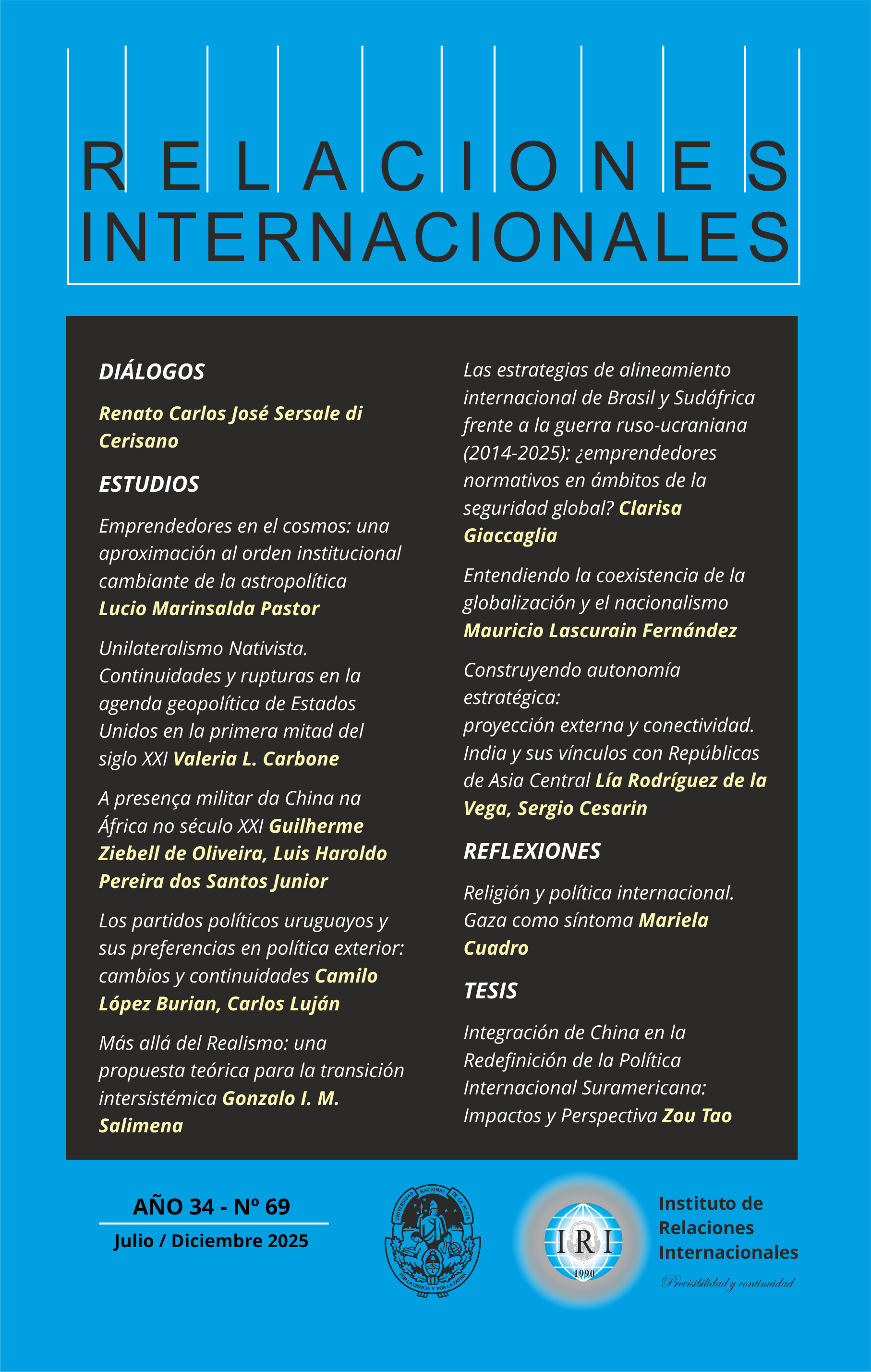
Downloads
Published
Issue
Section
License
Copyright (c) 2025 Lía Rodriguez de la Vega, Sergio Cesarín

This work is licensed under a Creative Commons Attribution-NonCommercial-ShareAlike 4.0 International License.
Aquellos autores/as que tengan publicaciones con esta revista, aceptan los términos siguientes:
- Los autores/as conservarán sus derechos de autor y garantizarán a la revista el derecho de primera publicación de su obra. A partir de noviembre del 2020 los artículos se publicarán en la revista bajo una licencia Creative Commons Atribución- NoComercial-CompartirIgual 4.0 Internacional (CC BY-NC-SA 4.0). Acorde a estos términos, el material se puede compartir (copiar y redistribuir en cualquier medio o formato) y adaptar (remezclar, transformar y crear a partir del material otra obra), siempre que a) se cite la autoría y la fuente original de su publicación (revista y URL de la obra), b) no se use para fines comerciales y c) se mantengan los mismos términos de la licencia.
Previo a esta fecha los artículos se publicaron en la revista bajo una Licencia de reconocimiento de Creative Commons (BY-SA 2.5). - Los autores/as podrán adoptar otros acuerdos de licencia no exclusiva de distribución de la versión de la obra publicada (p. ej.: depositarla en un archivo telemático institucional o publicarla en un volumen monográfico) siempre que se indique la publicación inicial en esta revista.
- Se permite y recomienda a los autores/as difundir su obra a través de Internet (p. ej.: en archivos telemáticos institucionales o en su página web) antes y durante el proceso de envío, lo cual puede producir intercambios interesantes y aumentar las citas de la obra publicada. (Véase El efecto del acceso abierto).