
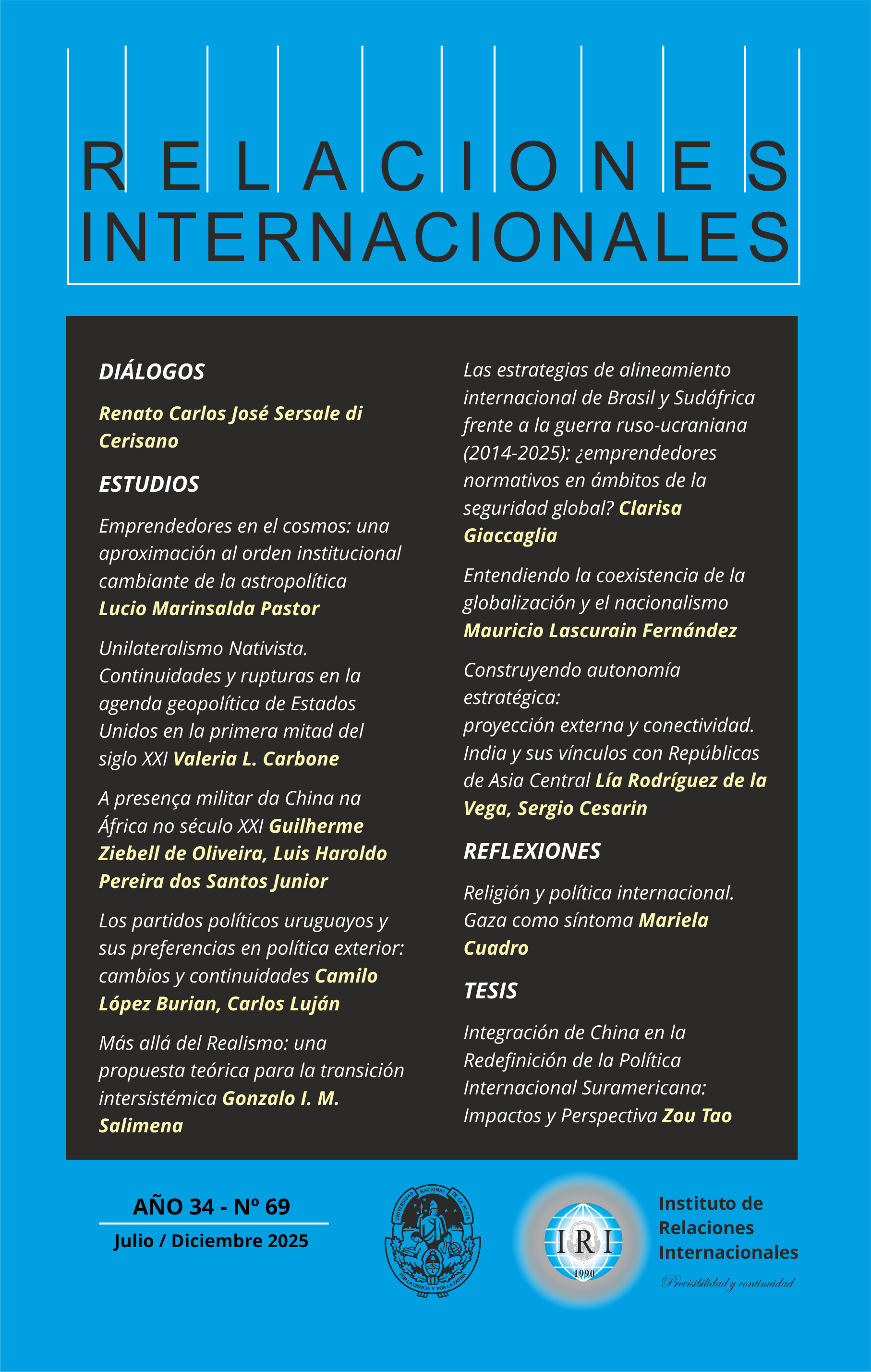
Understanding the coexistence of globalization and nationalism
DOI:
https://doi.org/10.24215/23142766e211Keywords:
Globalization, deglobalization, modern cosmopolitan perspective, nationalismAbstract
Globalization and deglobalization are social processes characterized by an increase or decrease in interdependence among nations. Currently, there is an ongoing debate as to whether the era of globalization has given way to an era of deglobalization. Globalization is associated with the modern cosmopolitan perspective, while deglobalization is associated with increasingly nationalist outlooks. Although these terms (deglobalization and nationalism) are closely interconnected in the context of this debate, they are not used as absolute synonyms, but rather as concurrent social processes that mutually reinforce one another. This debate has been further intensified by the 2008 financial crisis, which led to a rise in anti-immigration attitudes and nationalist sentiment. The purpose of this paper is to discuss whether globalization and deglobalization constitute opposing social processes, from both a historical and methodological perspective.
References
Appiah, K. A. (2007). Cosmopolitismo. La ética en un mundo de extraños. Katz.
Arnett, J. J. (2002). Psychology of globalization. American Psychologist, 57(0), 774–783. https://doi.org/10.1037/0003-066X.57.10.774
Beck, U. (1992). Risk society. SAGE.
Beck, U. y Willms, J. (2003). Conversations with Ulrich Beck. Polity Press.
Billig, M. (1995). Banal nationalism. SAGE.
Billig, M., Condor, S., Edwards, D. y Gane, M. (1981). Ideological dilemmas: A social psychology of everyday thinking. SAGE.
Bonanno, A. (2019). The crisis of neoliberalism, populist reaction, and the rise of authoritarian capitalism. International Review of Modern Sociology, 45(1), 9-26. https://www.jstor.org/stable/48636760
Bonifai, N., Rudra, N., Boulding, C. y Moya, S. (2022). Globalization and nationalism: Contending forces in world politics. International Studies Review, 24(2), viac021. https://doi.org/10.1093/isr/viac021
Butler, J. (2016). Frames of war: When is life grievable? VERSO.
Cardona, H. y Cardona, P. (2011). El Estado-nación en la globalización y en el reordenamiento internacional. Revista Ciencias Estratégicas, 19(25), 75-87. http://hdl.handle.net/20.500.11912/7558
Chernilo, D. (2020). Beyond the nation? Or back to it? Current trends in the sociology of nations and nationalism. Sociology, 54(6), 1072–1087. https://doi.org/10.1177/0038038520949831
Cox, L. (2021). Nationalism. Themes, theories, and controversies. Palgrave Macmillan.
Dekker, H., Malová, D. y Hoogendoorn, S. (2003). Nationalism and its explanations. Political Psychology, 24(2), 345-376. https://doi.org/10.1111/0162-895X.00331
Eagleton, T. (1991). Ideology: An introduction. Verso.
Fan, D. (2023). Managing globalized, deglobalized and reglobalized supply chains. Springer International Publishing.
Fox, J. E. (2017). The edges of the nation: A research agenda for uncovering the taken-for-granted foundations of everyday nationhood. Nations and Nationalism, 23(1), 26–47. https://doi.org/10.1111/nana.12269
Gao, Z. (2023). The politics of Chinese immigrants’ double unbelonging and deglobalization. Theory & Psychology, 33(2), 266–283. https://doi.org/10.1177/09593543221130728
Gellner, E. (1983). Nations and nationalism. New perspectives on the past. Cornell University Press.
Gerbaudo, P. (2021). The great recoil. Politics after populism and pandemic. Verso.
Gordon, G. (2013). The innate cosmopolitan tradition of international law. Cambridge International Law Journal, 2(4), 906-934. https://doi.org/10.7574/cjicl.02.04.142
Hobsbawm, E. y Ranger, T. (2012). The invention of tradition. Cambridge University Press
Inglehart, R. (1977). The silent revolution. Princeton University Press.
Irwin, D. (23 de abril de 2020). The pandemic adds momentum to the deglobalization trend. Pieterson Institute for International Economics. https://www.piie.com/blogs/realtime-economics/pandemic-adds-momentum-deglobalization-trend
James, H. (2018). Deglobalization: The rise of disembedded unilateralism. Annual Review of Financial Economics, 10, 219-237. https://doi.org/10.1146/annurev-financial-110217-022625
Karner, C. (2016). Negotiating national identities: between globalization, the past and 'the other'. Routledge.
Kettunen, P. (2018). The concept of nationalism in discussions on a European society. Journal of Political Ideologies, 23(3), 342-369. https://doi.org/10.1080/13569317.2018.1502943
Koch, N. y Paasi, A. (2016). Banal nationalism 20 years on: Re-thinking, re-formulating and re-contextualizing the concept. Political Geography, 54, 1-6. https://doi.org/10.1016/j.polgeo.2016.06.002
Lascurain, M. (2022). El proceso de globalización económica y los actuales movimientos populistas. Revista de Relaciones Internacionales, Estrategia y Seguridad, 17(1), 13-30. https://doi.org/10.18359/ries.5513
Lascurain, M. y Rodríguez-Gabarrón, R. (2021). Relaciones Internacionales en el siglo XXI. Una visión global. Editorial Anáhuac Xalapa.
Manfredi-Sánchez, J. L. (2021). Deglobalization and public diplomacy. International Journal of Communication, 15, 905-926.
Miller, D. (2009). Nationalism. En J. S. Dryzek, B. Honig y A. Phillips (Eds.), The Oxford Handbook of Political Theory (pp. 529–545). Oxford University Press. https://doi.org/10.1093/oxfordhb/9780199548439.003.0029
Mounk, Y. (2018). El pueblo contra la democracia: por qué nuestra libertad está en peligro y cómo salvarla. Ediciones Paidós.
Nussbaum, M. C. (2019). The cosmopolitan tradition. Harvard University Press.
Obstfeld, M. (2021). Globalization and nationalism: Retrospect and prospect. Contemporary Economic Policy, 39(4), 675-690. https://doi.org/10.1111/coep.12527
Rabinowitz, B. (2023). Defensive nationalism: Explaining the rise of populism and fascism in the 21st Century. Oxford University Press.
Reese, G., Rosenmann, A. y Cameron, J. E. (2019). The psychology of globalization. Identity, ideology and action. Academic Press.
Roberts-Miller, P. (2017). Demagoguery and democracy. The Experiment.
Robertson, R. (1992). Globalization. SAGE.
Rodríguez-Gabarrón, (2021). Gobernabilidad en el siglo XXI: democratización y desdemocratización en el nacimiento del nuevo orden mundial. En M. Lascurain Fernández y R. Rodríguez-Gabarrón (Coords.), Relaciones Internacionales en el siglo XXI. Una visión global (pp. 23-56). Editorial Anáhuac Xalapa.
Schlenker, A. y Blatter, J. (2014). Conceptualizing and evaluating (new) forms of citizenship between nationalism and cosmopolitanism. Democratization, 21(6), 1091-1116. https://doi.org/10.1080/13510347.2013.783820
Scott, S. (2019). The social life of nothing. Routledge.
Tajfel, H. y Turner, J. C. (1986). The social identity theory of intergroup behavior. En S. Worchel y W. Austin (Eds.), The social psychology of intergroup relations (pp. 276–293). Nelson Hall.
Teo, T. (2023). In the aftermath of globalization: Antiglobalizing and deglobalizing forms of subjectivity. Theory & Psychology, 33(2), 193–208. https://doi.org/10.1177/09593543221131507
Van Bergeijk, P. (2019). Deglobalisation 2.0. Edward Elgar.
Van Dijk, T. A. (2013). Ideology and discourse. En M. Freeden y M. Stears (Eds.), The Oxford Handbook of Political Ideologies (pp. 175–196). Oxford University Press.
Wimmer, A. (2018). Nation building. Princeton University Press.
Wodak, R. (2021). The politics of fear. SAGE.
World Trade Organization. (2022). World trade statistical review 2022. WTO. https://www.wto.org/english/res_e/publications_e/wtsr_2022_e.htm
Downloads
Published
Issue
Section
License
Copyright (c) 2025 Mauricio Lascurain Fernández

This work is licensed under a Creative Commons Attribution-NonCommercial-ShareAlike 4.0 International License.
Aquellos autores/as que tengan publicaciones con esta revista, aceptan los términos siguientes:
- Los autores/as conservarán sus derechos de autor y garantizarán a la revista el derecho de primera publicación de su obra. A partir de noviembre del 2020 los artículos se publicarán en la revista bajo una licencia Creative Commons Atribución- NoComercial-CompartirIgual 4.0 Internacional (CC BY-NC-SA 4.0). Acorde a estos términos, el material se puede compartir (copiar y redistribuir en cualquier medio o formato) y adaptar (remezclar, transformar y crear a partir del material otra obra), siempre que a) se cite la autoría y la fuente original de su publicación (revista y URL de la obra), b) no se use para fines comerciales y c) se mantengan los mismos términos de la licencia.
Previo a esta fecha los artículos se publicaron en la revista bajo una Licencia de reconocimiento de Creative Commons (BY-SA 2.5). - Los autores/as podrán adoptar otros acuerdos de licencia no exclusiva de distribución de la versión de la obra publicada (p. ej.: depositarla en un archivo telemático institucional o publicarla en un volumen monográfico) siempre que se indique la publicación inicial en esta revista.
- Se permite y recomienda a los autores/as difundir su obra a través de Internet (p. ej.: en archivos telemáticos institucionales o en su página web) antes y durante el proceso de envío, lo cual puede producir intercambios interesantes y aumentar las citas de la obra publicada. (Véase El efecto del acceso abierto).