
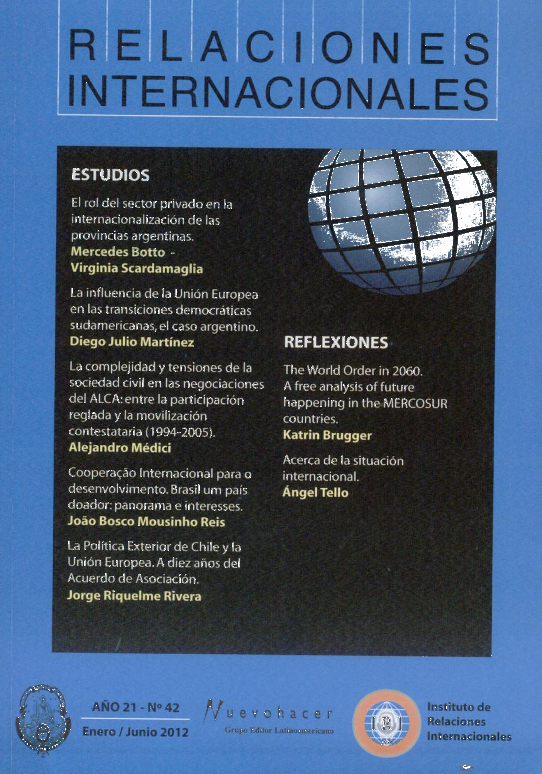
La influencia de la Unión Europea en las transiciones democráticas sudamericanas, el caso argentino
Abstract
The aim of this job is to show the influence that Europe has over the Southamerican reality as regards the context of the democratic transitions of the 80’s decade. To explain that influence, a special reference on the Argentine case has been done, just for two main reasons; firstly, the relevance that Argentina had due to its characteristics, a dictatorial government that rudely repressed the civil society, and the post Malvinas war crisis which caused an immediate call for elections in October 1983. Secondly, those particular matters were the consequence of the leadership of Dr Raul Alfonsin. As a result, he turned out to be an actor of a huge incidence over the rest of the Southamerican transitions.
From the point of view of Dr Alfonsin’s government, the Southamerican transitions are a big opportunity to guarantee the democratic stability with the overcoming of historical matters, those objectives are a clear reference to the European situation, summarized in the idea of “a constructive process of peace and integration in the region”.
Downloads
Published
Issue
Section
License
Aquellos autores/as que tengan publicaciones con esta revista, aceptan los términos siguientes:
- Los autores/as conservarán sus derechos de autor y garantizarán a la revista el derecho de primera publicación de su obra. A partir de noviembre del 2020 los artículos se publicarán en la revista bajo una licencia Creative Commons Atribución- NoComercial-CompartirIgual 4.0 Internacional (CC BY-NC-SA 4.0). Acorde a estos términos, el material se puede compartir (copiar y redistribuir en cualquier medio o formato) y adaptar (remezclar, transformar y crear a partir del material otra obra), siempre que a) se cite la autoría y la fuente original de su publicación (revista y URL de la obra), b) no se use para fines comerciales y c) se mantengan los mismos términos de la licencia.
Previo a esta fecha los artículos se publicaron en la revista bajo una Licencia de reconocimiento de Creative Commons (BY-SA 2.5). - Los autores/as podrán adoptar otros acuerdos de licencia no exclusiva de distribución de la versión de la obra publicada (p. ej.: depositarla en un archivo telemático institucional o publicarla en un volumen monográfico) siempre que se indique la publicación inicial en esta revista.
- Se permite y recomienda a los autores/as difundir su obra a través de Internet (p. ej.: en archivos telemáticos institucionales o en su página web) antes y durante el proceso de envío, lo cual puede producir intercambios interesantes y aumentar las citas de la obra publicada. (Véase El efecto del acceso abierto).