
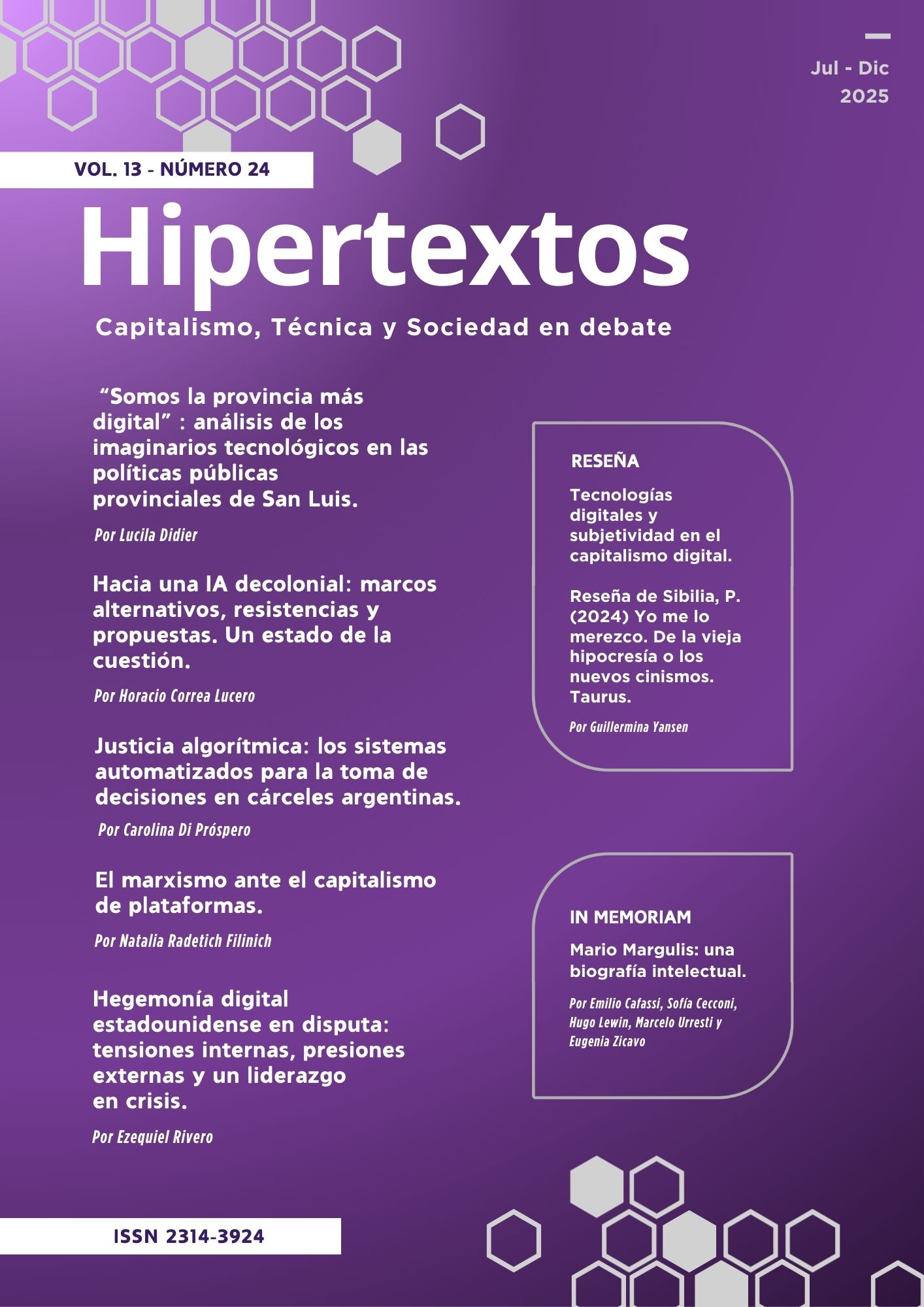
U.S. Digital Hegemony in Dispute
: Internal Tensions, External Pressures, and a Leadership in Crisis
DOI:
https://doi.org/10.24215/23143924e109Keywords:
platform capitalism, digital hegemony, United States, technological sovereigntyAbstract
This article analyzes the political and economic foundations of the United States' digital hegemony, focusing on its historical consolidation and the current tensions it faces. Drawing on a critical political economy perspective, it examines how the U.S.-led platform capitalism model—driven by major tech companies—has become a central vector of economic, symbolic, and normative power, aligning public and private interests around the national techno-industrial complex. The study identifies a relative crisis in this hegemony, driven by three main factors: external pressures from regulatory processes in other countries, especially in Europe; China's technological rise as a systemic competitor; and a growing internal loss of legitimacy, reflected in lawsuits, legislative proposals, and increasingly critical public opinion. Through an analysis of economic, commercial, and technological indicators, the paper argues that Big Tech’s power is being challenged both externally and internally, including by the U.S. state itself. The article concludes that this contradiction places the U.S. government in a strategic dilemma: to limit the power of its digital companies without weakening their role in geopolitical projection. In light of this scenario, the article raises an open question about the possible resolutions and highlights that the crisis of digital hegemony opens a window of opportunity to revive discussions on technological sovereignty, particularly in the Global South.
References
Alves, G. (2020). A crise estrutural do capitalismo global: o capital diante de seus limites no século XXI. En A. A. S. de Sousa, A. C. O. de Oliveira y L. B. da Silva (Orgs.), Trabalho e os limites do capitalismo: novas facetas do neoliberalismo (pp. 49–66). Navegando Publicações.
Becerra, M. y Waisbord, S. (2024). Soberanía y nacionalismo en entornos digitales: la llamativa ausencia de América Latina en el debate mundial. Signo y Pensamiento, 43. https://doi.org/10.11144/Javeriana.syp43.sned
Bilic, P., Prug, T. y Zitko, M. (2021). The political economy of digital monopolies: Contradictions and alternatives to data commodification. Bristol University Press.
Bolaño, C. (2013). Industria cultural, información y capitalismo. (1ª ed.). Gedisa.
Bolaño, C. R., Barreto, H. M. do R. y Rivero, E. A. (2025). Regulação de plataformas e soberania digital. Liinc em Revista, 21(1), e7530. https://doi.org/10.18617/liinc.v21i1.7530
Bolaño, C. R., Martins, H. y Valente, J. (2022). Para a análise teórico-metodológica das plataformas digitais como estruturas de mediação a partir da Economia Política da Comunicação. Avatares de la Comunicación y la Cultura, 24. https://doi.org/10.62174/avatares.2022.7615
Bonnamy, C. y Perarnaud, C. (2024). Introduction. EU Digital Policies and Politics: Unpacking the European Approach to Regulate the “Digital”. Politique Européenne, 81(3), 8–27.
Bradford, A. (2020). The Brussels effect: How the European Union rules the world. Oxford University Press.
Bradford, A. (2024). Imperios digitales. La batalla global por la tecnología que marcará la geopolítica del futuro. Shackleton Books.
Cant, C. (2020). Riding for Deliveroo: Resistance in the new economy. Polity Press.
Caisilli, A., Tubaro, P., Le Ludec, C. y Wahal, E. (2019). En la trastienda de la inteligencia artificial. Una investigación sobre las plataformas de micro-trabajo en Francia. Arxius de Ciències Socials, 41, 85–108.
Cancela, E. (2023). Utopías digitales. Imaginar el fin del capitalismo. Verso.
Chesnais, F. (1996). A mundialização do capital. Xamã.
Cófreces, J. (2024). Capitalismo de plataformas y neoliberalismo: reconstrucción de una alianza socio-técnica. Hipertextos, 12(21), e080. https://doi.org/10.24215/23143924e080
Couldry, N. y Mejias, U. (2019). The costs of connection: How data is colonizing human life and appropriating it for capitalism. Stanford University Press.
Flew, T. (2021). Regulating platforms. (1ª. ed.). Polity.
Flew, T., Martin, F. y Suzor, N. (2019). Internet regulation as media policy: Rethinking the question of digital communication platform governance. Journal of Digital Media and Policy, 10(1), 33–50.
Girado, G. (2021). Un mundo made in China: la larga marcha hacia la creación de un nuevo orden global. Capital Intelectual.
Jia, K. y Kenney, M. (2022). The Chinese platform business group: An alternative to the Silicon Valley model? Journal of Chinese Governance, 7(1), 58–80.
Jia, L. y Nieborg, D. (2022). Analyzing Chinese platform power: Infrastructure, finance and geopolitics. En R. Hoyng, G. Chong y L. Pak (Eds.), Critiquing innovation: New media in a multipolar world (pp. 1–28). Michigan State University Press.
Khan, L. M. (2017). Amazon’s antitrust paradox. The Yale Law Journal, 126(3), 710–805. https://www.yalelawjournal.org/note/amazons-antitrust-paradox
Khan, L. M. (2018). The ideological roots of America’s market power problem. The Yale Law Journal Forum, 127, 960–979. https://www.yalelawjournal.org/forum/the-ideological-roots-of-americas-market-power-problem
Lessig, L. (1998). Laws of cyberspace [Conferencia]. Taiwan NET 98. Taipei, Taiwan.
Mandel, E. (1979). El capitalismo tardío. Ediciones ERA.
Martins, H. (2025). La gobernanza económica de las plataformas digitales en la Unión Europea [Informe de investigación posdoctoral]. Obscom. https://obscomplataformas.com.br/relatorios
Ministerio da Fazenda. (2024). Plataformas digitais, concorrência e regulação: uma análise da experiência comparada. Secretaria de Reformas Econômicas.
Mueller, M. L. (2015). Hyper-transparency and social control: Social media as magnets for regulation. Telecommunications Policy, 39(9), 804–810. https://doi.org/10.1016/j.telpol.2015.05.001
Nieminen, H., Padovani, C. y Sousa, H. (2023). Why has the EU been late in regulating social media platforms? Javnost – The Public, 30(2), 174–196.
Noam, E. (2009). Media ownership and concentration in America. Oxford University Press.
Radetich Filinich, N. (2022). Cappitalismo. La uberización del trabajo. Siglo XXI Editores.
Radetich Filinich, N. (2023). La smartphonización de la vida social. Cuestiones de Sociología, 27, 1–18. https://doi.org/10.24215/23468904e148
Schaake, M. (2024). The tech coup: How to save democracy from Silicon Valley. Princeton University Press.
Scholz, T. (2013). Digital labor. The internet as playground and factory. Routledge.
Scholz, T. (2016). Cooperativismo de plataforma. Desafiando la economía colaborativa corporativa. Digital Communs Research Group.
Scholz, T. (2017). Uberworked and Uberpaid. How workers are disrupting the digital economy. Polity Press.
Srnicek, N. (2018). Capitalismo de plataformas. (1ª ed.). Caja Negra.
Statista. (2019). China, mayor productor del mundo de minerales raros. https://es.statista.com/grafico/18296/produccion-mineral-de-tierras-raras/
Sykes, J. B. (2021). The big tech antitrust bills. Congressional Research Service, R46875. https://crsreports.congress.gov/product/pdf/R/R46875/3
Valente, J. (2019). Tecnologia, informação e poder: das plataformas online aos monopólios digitais [Tesis de doctorado, Universidade de Brasília]. https://repositorio.unb.br/handle/10482/36948
Van Dijck, J. (2022). Ver a floresta por suas árvores: visualizando plataformização e sua governança. Matrizes, 16(2), 21–44.
Williams, R. (2011). Televisión. Tecnología y forma cultural. (Trad. A. Bixio). Paidós. (Trabajo original publicado en 1974).
Winseck, D. (2019). Internet infrastructure and the persistent myth of U.S. hegemony. En B. Haggart, K. Henne y N. Tusikov (Eds.), Information, technology and control in a changing world (pp. 93–120). Palgrave Macmillan. https://doi.org/10.1007/978-3-030-14540-8_5
Wu, T. (2018). The curse of bigness: Antitrust in the new gilded age. Columbia Global Reports. https://scholarship.law.columbia.edu/books/63/
Zuboff, S. (2025). ¿Capitalismo de vigilancia o democracia? Una lucha a todo o nada en la era de la información. UNSAM Edita.
Zukerfeld, M. (2010). De niveles, regulaciones capitalistas y cables submarinos: Una introducción a la arquitectura política de Internet. VIRTUalis, 1, 5–21.
Zukerfeld, M. (2014). Todo lo que usted quiso saber sobre Internet pero nunca se atrevió a googlear. Hipertextos, 1(2), 64–103.
Downloads
Published
Issue
Section
License

This work is licensed under a Creative Commons Attribution-NonCommercial-NoDerivatives 4.0 International License.