
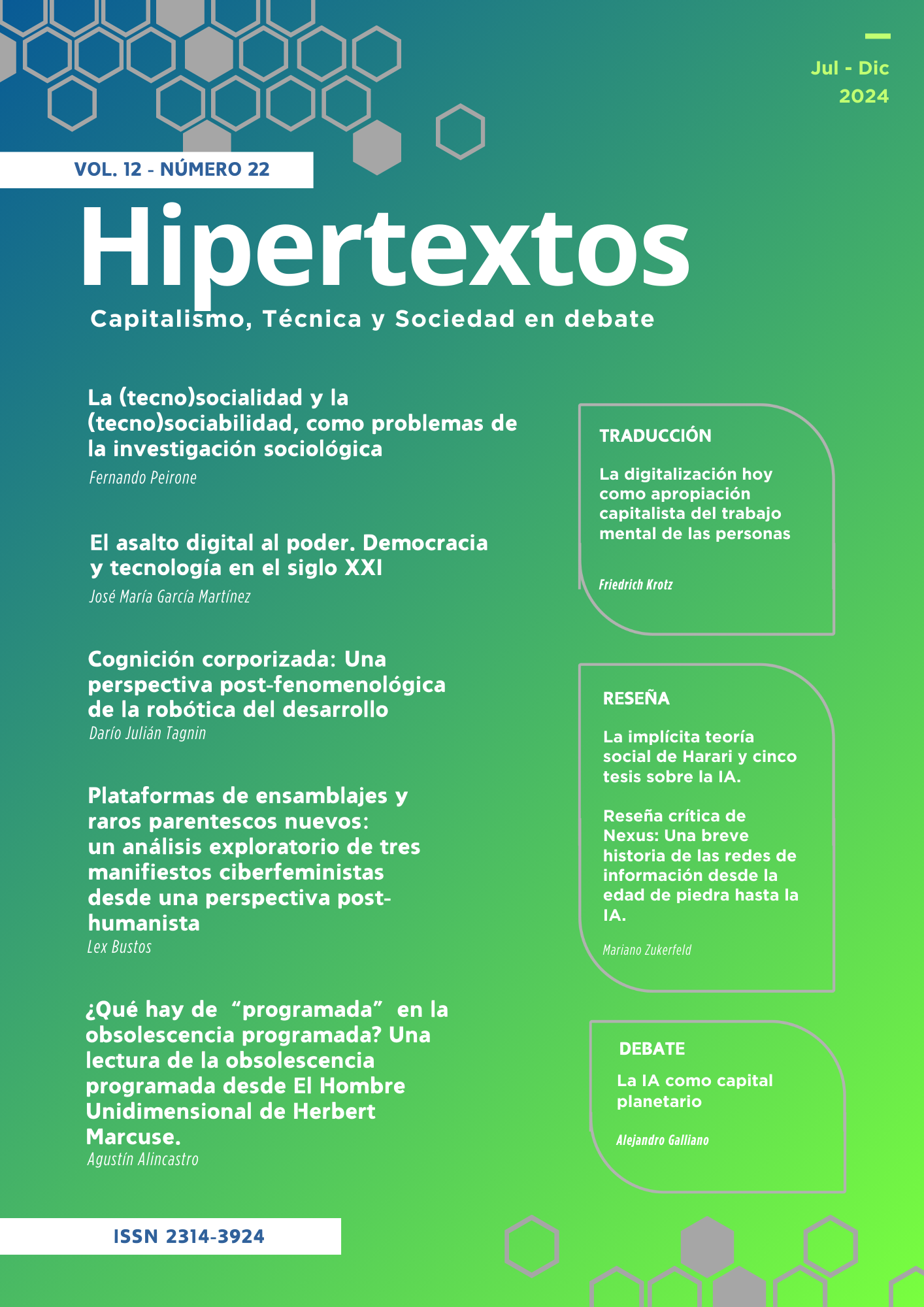
What is “planned” in planned obsolescence?
A reading of planned obsolescence through Herbert Marcuse’s One-Dimensional Man
DOI:
https://doi.org/10.24215/23143924e093Keywords:
planned obsolescence, Herbert Marcuse, technology, consumption, rationalizationAbstract
Planned obsolescence is generally understood as a business-industrial strategy designed by monopolies and oligopolies in the technical product design to encourage consumption. By reducing its effective usage time, it becomes unusable (obsolete) and turns into waste. However, if we consider the perspective of the philosopher Herbert Marcuse, who in his seminal work One-Dimensional Man analyzes advanced industrial society to expose a process of technological rationalization in various socio-technical phenomena deemed rational and necessary in production and consumption, planned obsolescence appears not only as an intentional strategy of companies within industrial production but also as a trend that consolidates as an internal law of the production process that shapes consumer habits. The materialization of scientific-technical rationality in production and consumer products contains an ideology centred on the efficient reproduction of the productive system, which prevents considering the irrationality of destructive consequences such as waste and pollution—from a sustainable perspective—by viewing planned obsolescence as an inevitable practice. Advanced industrial society intensifies certain production logics as necessary determinations in the manufactured product, including imposing an expiration date on the object to perpetuate consumption; this normalizes planned obsolescence as a necessary byproduct of technical progress and economic growth. The technical-productive apparatus reproduces a particular way of understanding and constructing the technical world, and concretizes one-dimensional practices that are seen as harmless regarding the consumer. But planned obsolescence, as a socio-technical phenomenon, promotes a certain sensitivity and habits of thought related to dispensable items, aligned with consumption as a mode of production and the rationalization of the technical-industrial system.
References
Bulow, J. (1986). An Economic Theory of Planned Obsolescence. The Quarterly Journal of Economics, 101(4), 729-750. https://doi.org/10.2307/1884176
Cupani, A. O. (2018). Sobre la dificultad de entender filosóficamente la tecnología. ArtefaCToS. Revista de Estudios Sobre la Ciencia y la Tecnología, 7(2), 127. https://doi.org/10.14201/art201872127144
Durkheim, E. (2013). La división del trabajo social. Minerva.
Feenberg, A. (2005). Teoría crítica de la tecnología. Revista Iberoamericana de Ciencia, Tecnología y Sociedad - CTS, 2(5), 109–123.
Farjat, M. J. G. (2021). Reflexiones acerca del papel de la tecnología en el pensamiento marcusiano en el marco de la sociedad industrial avanzada. Revista Tecnologia e Sociedade, 17(47). https://doi.org/10.3895/rts.v17n47.11064
Fisher, M. (2018). Realismo capitalista. ¿No hay alternativa?. Caja Negra.
Griziotti, G. (2017). Neurocapitalismo: Mediaciones tecnológicas y líneas de fuga. (1ª ed.). Melusina.
Horkheimer, M. (2002). Crítica de la razón instrumental. Trotta.
Hui, Y. (2020). Fragmentar el futuro: Ensayos sobre tecnodiversidad. Caja Negra.
Kant, I. (1996). Fundamentación de la metafísica de las costumbres. Ariel.
Latouche, S. (2018). Hecho para tirar: la irracionalidad de la obsolescencia programada. (1ª ed.). Octaedro.
London, B. (1932). Ending the Depression Through Planned Obsolescence. https://upload.wikimedia.org/wikipedia/commons/2/27/London_%281932%29_Ending_the_depression_through_planned_obsolescence.pdf
Marcuse, H. (1969). La sociedad industrial y el marxismo. Quintaria.
Marcuse, H. (1983). Eros y civilización. Sarpe.
Marcuse, H. (1993). El hombre unidimensional: Ensayo sobre la ideología de la sociedad industrial avanzada. Planeta-Agostini.
Martínez, A. N. y Porcelli, A. M. (2017). Consumo (in)sostenible: Nuevos desafíos frente a la obsolescencia programada como compromiso con el ambiente y la sustentabilidad. Ambiente y Sostenibilidad, 6(2016), 105–135. https://doi.org/10.25100/ays.v0i0.4294
Noro, J. E. (2021). De la obsolescencia programada a la contingencia ontológica. Cuenca - Coloquio, 21(66), 11–27.
Taylor, C. (2014). Hegel y la sociedad moderna. (1ª ed.). Fondo de Cultura Económica.
Weber, M. (2008). El sabio y la política. Universidad Nacional de Córdoba-Encuentro.
Downloads
Published
Issue
Section
License

This work is licensed under a Creative Commons Attribution-NonCommercial-NoDerivatives 4.0 International License.