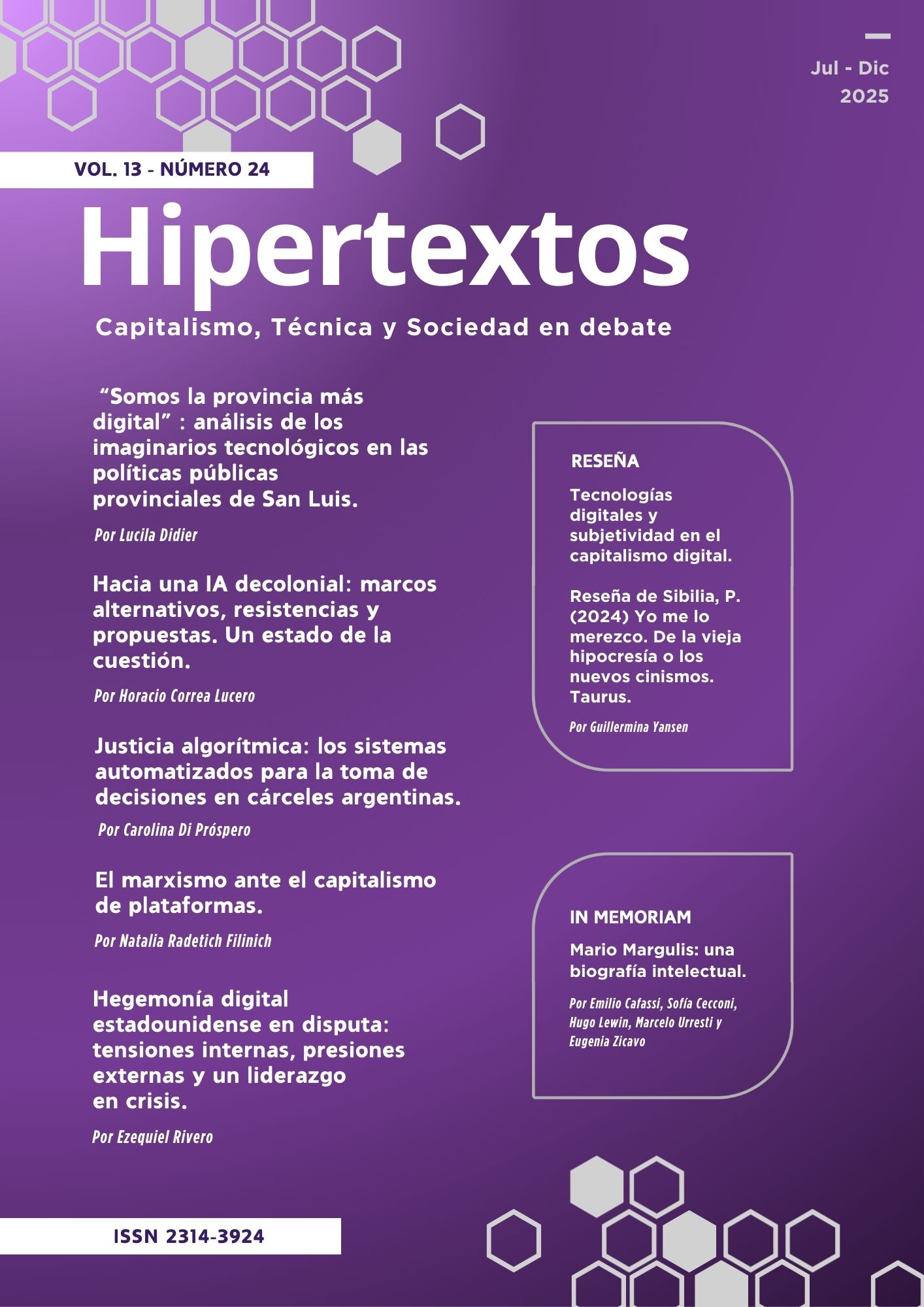
Toward a Decolonial AI: Alternative Frameworks, Resistances, and Proposals. A State-of-the-Art Review
Un estado de la cuestión
DOI:
https://doi.org/10.24215/23143924e106Keywords:
colonialism in AI, decolonial AI, alternative ethical frameworks, relational ontologies, epistemologies of resistance.Abstract
The paper presents a state-of-the-art review with respect to the proposed ways to achieve a decolonial AI that stands in opposition to the structural colonial and capitalist foundations inherited from historical colonialism. This objective involves a qualitative methodology based on thematic text analysis, with a focus on the classification of patterns, categories, subcategories, and concepts. The identified pattern suggests continuity with historical colonialism, where AI appears as a technology that maintains and reinforces that condition. Such a pattern reproduces historical inequalities suffered by Indigenous and marginalized communities. Under these circumstances, AI must oppose this configuration through a decolonial approach. For the pattern to qualify as such, it must receive support from all analyzed texts through concepts oriented toward that objective. The identified pattern fulfills this requirement. Furthermore, categories arise through the unification of concepts that share thematic affinities. The article recognizes three categories. The first encompasses concepts that propose alternative ethical, ontological, and epistemic frameworks for an inclusive AI. The second category includes concepts that address strategies related to resistance and community empowerment. The third category integrates concepts that set forth proposals for the design and implementation of a decolonial AI. The subcategories subdivide these three categories, and both categories and subcategories emerge from analytical construction, in contrast to the concepts, which appear in their literal form as extracted from the analyzed texts. The article organizes its structure according to this categorical classification. The systematic arrangement of this subject matter, which is currently in development and of notable relevance, constitutes its principal contribution.
References
Abdilla, A. (2018). Beyond Imperial Tools: Future-proofing technology through indigenous governance and tradicional knowledge systems. En J. Harle, A. Abdila, y A. Newman (Eds.), Decolonising the dgital: Technology as cultural practice (pp. 67–81). Tactical Space Lab.
Abela, J. A. (2001). Las técnicas de análisis de contenido: una revisión actualizada. Centro de Estudios Andaluces.
Adams, R. (2021). Can artificial intelligence be decolonized? Interdisciplinary Science Reviews, 46(1–2), 176–197. https://doi.org/10.1080/03080188.2020.1840225
Anderson, R. (2007). Thematic content analysis (TCA): Descriptive presentation of qualitative data. Institute of Transpersonal Psychology.
Baudrillard, J. (1984). Simulacra and simulation. University of Michigan
Birhane, A., Isaac, W., Prabhakaran, V., Díaz, M., Elish, M. C., Gabriel, I. y Mohamed, S. (2022). Power to the people? Opportunities and challenges for participatory AI. Equity and Access in Algorithms, Mechanisms, and Optimization, (EAAMO ’22), 6. https://doi.org/10.1145/3551624.3555290
Bonaldo, R., y Pereira, A. C. B. (2023). Potential History: Reading Artificial Intelligence from Indigenous Knowledges. History and Theory, 62(1), 3–29. https://doi.org/10.1111/hith.12290
Couldry, N. y Mejias, U. A. (2018). Data Colonialism: Rethinking big data’s relation to the contemporary subject. Television & New Media, 0(0), 1–14. https://doi.org/10.1177/1527476418796632
Couldry, N. y Mejias, U. A. (2019). The costs of connection: How data is colonizing human life and appropriating it for capitalism. Stanford University Press.
Couldry, N. y Mejias, U. A. (2023). The decolonial turn in data and technology research: What is at stake and where is it heading? Information, Communication & Society, 26(4), 786–802. https://doi.org/10.1080/1369118X.2021.1986102
Gallamaso, J. D. (2024). Indigenous culture in the age of artificial intelligence: Challenges and moral responsibility. Ignatian International Journal for Multidisciplinary Research, 2(7), 824–837. https://doi.org/10.5281/zenodo.13105236
Humble, N. y Mozelius, P. (2022). Content analysis or thematic: Doctoral students’ perceptions of similarities and differences. Electronic Journal of Business Research Methods, 20(3), 89–98. https://doi.org/10.34190/ejbrm.20.3.2920
Kesserwan, K. (16 de febrero de 2018). How can Indigenous knowledge shape our view of AI? Policy Options. https://policyoptions.irpp.org/magazines/february-2018/how-can-indigenous-knowledge-shape-our-view-of-ai/
Kwet, M. (2019). Digital colonialism: US empire and the new imperialism in the Global South. Race & Class, 60(4), 3–26.
Lewis, J. E. (2023). Imagining indigenous AI. En S. Cave y K. Dihal (Eds.), Imagining AI: How the world sees intelligent machines (pp. 210–217). Oxford University Press.
Lewis, J. E., Arista, N., Pechawis, A. y Kite, S. (2018). Making kin with the machines. Journal of Design and Science, 3.5. https://doi.org/10.21428/bfafd97b
López Flores, L. M. (2022). Colonialidad algorítmica: racialización y sexualización mecanizada en el capitalismo digital. Teknokultura. Revista de Cultura Digital y Movimientos Sociales, 19(2), 231–239. https://doi.org/10.5209/tekn.78681
Love, H. R. y Corr, C. (2022). Integrating without quantitizing: Two examples of deductive analysis strategies within qualitatively driven mixed methods research. Journal of Mixed Methods Research, 16(1), 64–87. https://doi.org/10.1177/1558689821989833
Maitra, S. (2020). Artificial intelligence and indigenous perspectives: Protecting and empowering intelligent human beings. Proceedings of the AAAI/ACM Conference on AI, Ethics, and Society, AIES '20, 320–326. https://doi.org/10.1145/3375627.3375845
Mbembe, A. (2021). Out of the dark night: Essays on decolonization. Columbia University Press.
Mhlambi, S. y Tiribelli, S. (2023). Decolonizing AI ethics: Relational autonomy as a means to counter AI harms. Topoi, 42(3), 867–880. https://doi.org/10.1007/s11245-022-09874-2
Mignolo, W. D. (2000). Local histories/global designs: Coloniality, subaltern knowledges, and border thinking. Princeton University Press.
Mignolo, W. D. (2003). La colonialidad a lo largo y a lo ancho: el hemisferio occidental en el horizonte colonial de la modernidad. En E. Lander (Ed.), La colonialidad del saber: eurocentrismo y ciencias sociales, perspectivas latinoamericanas (pp. 35-55). CLACSO.
Mohamed, S., Png, M.-T. y Isaac, W. (2020). Decolonial AI: Decolonial theory as sociotechnical foresight in artificial intelligence. Philosophy & Technology, 33(4), 659–684. https://doi.org/10.1007/s13347-020-00405-8
Mollema, W. J. T. (2024). Decolonial AI as disenclosure. Open Journal of Social Sciences, 12(02), 574–603. https://doi.org/10.4236/jss.2024.122032
Muldoon, J. y Wu, B. A. (2023). Artificial Intelligence in the colonial matrix of power. Philosophy & Technology, 36(4), 80. https://doi.org/10.1007/s13347-023-00687-8
Nancy, J. L. (2011). La communauté désoeuvrée. Christian Bourgois éditeur.
Quijano, A. (2000). Colonialidad del poder, eurocentrismo y América Latina. CLACSO.
Quijano, A. (2007). Coloniality and modernity/rationality. Cultural Studies, 21(2–3), 168–178. https://doi.org/10.1080/09502380601164353
Ricaurte, P. (2019). Data epistemologies, coloniality of power, and resistance. Television & New Media, 20(4), 350–365. https://doi.org/10.1177/1527476419831640
Ricaurte, P. (2022). Ethics for the majority world: AI and the question of violence at scale. Media, Culture & Society, 44(4), 726–745. https://doi.org/10.1177/01634437221099612
Ricaurte, P. (2024). AI, ethics, and coloniality: A feminist critique. En M. Cebral Loureda, E. Ricón Flores y G. Sánchez Ante (Eds.), What AI can do. Strenthgs and Limitations of Artificial Intelligence (p. 459). CRC Press.
Robledo Maturana, R. (2023). Los condenados del algoritmo. Inteligencia artificial y cuerpos racializados latinoamericanos. Pléyade, 32, 130–159. https://doi.org/10.4067/S0719-36962023000200130
Vargas Mariño, A. F. (2023). Deus ex machina: inteligencia artificial frente a la pluralidad epistémica. Nómadas, 57, n57a5. https://doi.org/10.30578/nomadas.n57a5
Varon, J. y Peña, P. (2021). Artificial intelligence and consent: A feminist anti-colonial critique. Internet Policy Review, 10(4), 1–25.
Viveiros de Castro, E. y Fernandes, P. (2012). A indianidade é um projeto de futuro, não uma memória do passado: Entrevista com Eduardo Viveiros de Castro. Prisma Juridico, 10(2), 257–268. https://doi.org/10.5585/prismaj.v10i2.3311
Zuboff, S. (2019). The age of surveillance capitalism: The fight for a human future at the new frontier of power: Barack Obama’s Books of 2019. Profile Books.
Downloads
Published
Issue
Section
License

This work is licensed under a Creative Commons Attribution-NonCommercial-NoDerivatives 4.0 International License.