
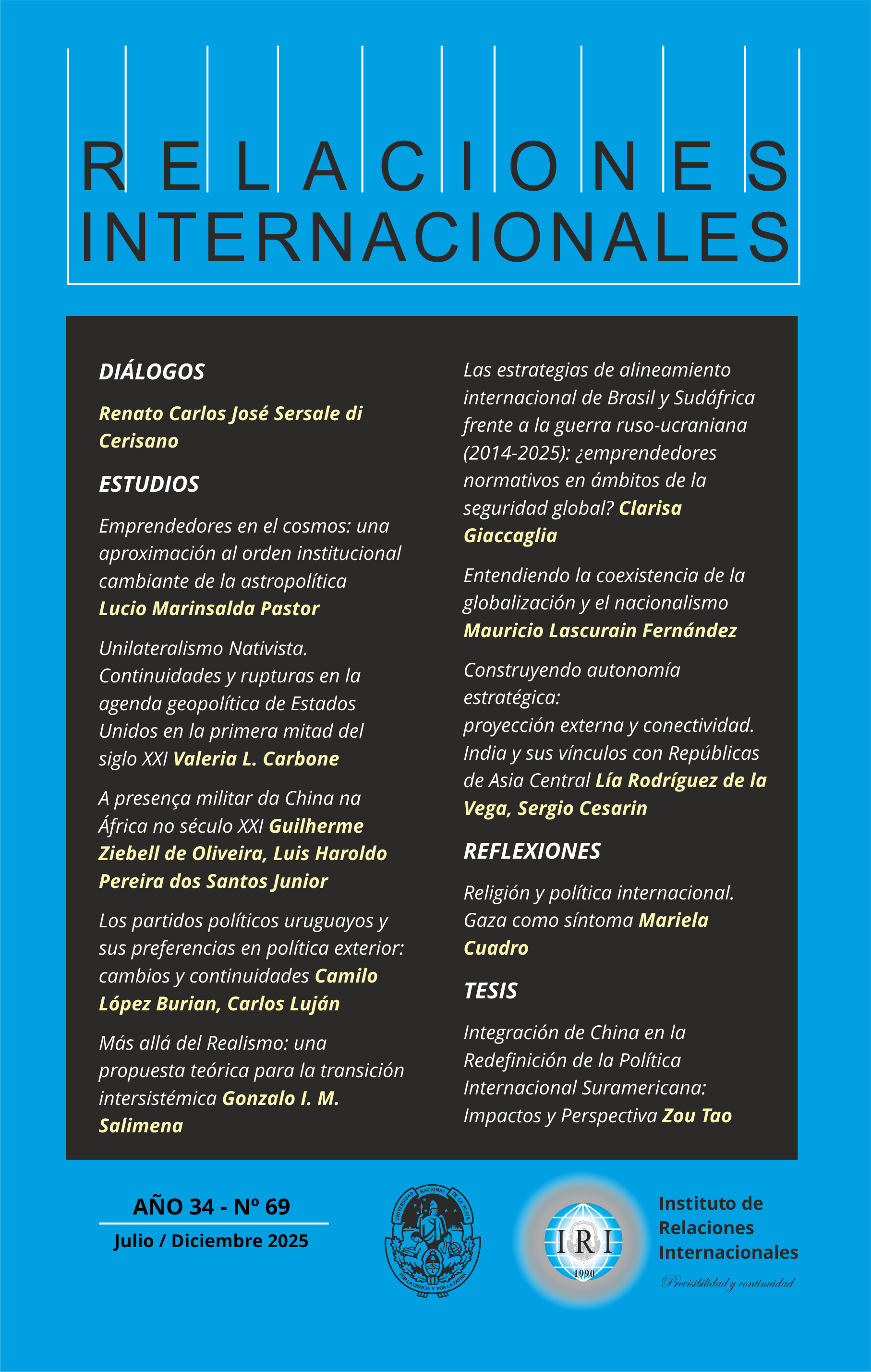
La presencia militar de China en África en el siglo XXI
DOI:
https://doi.org/10.24215/23142766e212Palabras clave:
China, África, Cooperación, Presencia militarResumen
El trabajo busca analizar si la retórica oficial china de un mayor compromiso en la dinámica de seguridad africana desde mediados de la década de 2000 se traduce en términos prácticos en el contexto de la cooperación militar con el continente. Para ello, se examinan los principios que sustentan las relaciones sino-africanas desde la década de 1950, así como las motivaciones y posibles iniciativas chinas en la dinámica de seguridad africana en el siglo XXI. Se plantea la hipótesis de que hay una presencia militar china más grande, que resulta del reconocimiento de que mantener la seguridad de sus socios cumple con los objetivos de proteger sus propios intereses en el exterior y asegurar su influencia en la región.
Referencias
Abegunrin, O. y Manyeruke, C. (2020). China’s power in Africa: A new global order. Palgrave Macmillan
Alden, C. (2007). China in Africa. Zed Books.
Alden, C., Large, D. y Soares De Oliveira, R. (2008). China returns to Africa: A rising power and a continent embrace. Hurst Publishers Ltd.
Alden, C. y Alves, A. C. (2009). China and Africa’s natural resources: The challenges and implications for development and governance. South African Institute of International Affairs.
Alden, C., Alao, A., Zhang, C. y Barber, L. (2018). China and Africa: Building peace and security cooperation in the continent. Palgrave Macmillan.
Alden, C. y Zheng, Y. (2018). China’s changing role in peace and security in Africa. En C. Alden, A. Alao, C. Zhang y L. Barber (Eds.), China and Africa: Building peace and security cooperation in the continent (pp. 39-66). Palgrave Macmillan.
Barton, B. (2018). China’s security policy in Africa: A new or false dawn for the evolution of the application of China’s non-interference principle? South African Journal of International Affairs, 25(3), 413-434. https://doi.org/10.1080/10220461.2018.1526707
Benabdallah, L. (2016). China’s peace and security strategies in Africa: Building capacity is building peace? African Studies Quarterly, 16(3-4), 17-34.
Brautigam, D. (2009). The dragon’s gift: The real story of China in Africa. Oxford University.
Cabestan, J. (2022). China’s military base in Djibouti: A microcosm of China’s growing competition with the United States and new bipolarity. En Z. Suisheng (Ed.), China's big power ambition under Xi Jinping: Narratives and driving forces (pp.169-186). Routledge.
Carrozza, I. (2019). China’s multilateral diplomacy in Africa: Constructing the security-development nexus. En D. Johanson, L. Jie y W. Tsunghan (Eds.), New perspectives on China’s relations with the world (pp. 142-158). E-International Relations Publishing.
Chazan, N., Lewis, P., Mortimer, R., Rothchild, D. y Stedman, S. (1999). Politics and society in contemporary Africa. Lynne Rienner Publishers.
Chin-Hao, H. y Ismail, O. (2016). China. En O. Ismail y E. Sköns (Eds.), Security activities of external actors in Africa (pp. 15-37). Oxford University.
China Ministry of Foreign Affairs. (2000). A long-term stable China-Africa relationship of all-round cooperation. FMPRC. https://www.fmprc.gov.cn/eng/zy/wjls/3604_665547/202405/t20240531_11367569.html
Clapham, C. (1996). Africa and the international system: The politics of state survival. Cambridge University.
Declaration of the Beijing Summit Of the Forum On China-Africa Cooperation. (2006). Embassy of the People’s Republic of China in the Republic of South Africa. http://za.china-embassy.gov.cn/eng/jbwzlm/zfgxss/zywx/201206/t20120621_7682380.htm
Dent, C. (2011). Africa and China: A new kind of development partnership. En C. Dent (Ed.), China and Africa Development Relations (pp. 3-20). Routledge.
Dutton, P., Kardon, I. y Kennedy, C. (2020). China Maritime Report N° 6: Djibouti: China’s first overseas strategic strongpoint. U.S. Naval War College.
Erickson, A. y Strange, A. (2015). China’s blue soft power: Antipiracy, engagement, and image enhancement. Naval War College Review, 68(1), 71-91. https://www.jstor.org/stable/26397817
Escosteguy, P. (2011). A nova arquitetura de paz e segurança: implicações para o multilateralismo e para as relações do Brasil com a África. Fundação Alexandre de Gusmão.
Forum on China-Africa Cooperation. (16 de noviembre de 2006). Forum on China-Africa Beijing Action Plan (2007-2009). FOCAC. http://www.focac.org/eng/zywx_1/zywj/200611/t20061116_7933564.htm
Forum on China-Africa Cooperation. (12 de noviembre de 2009). Forum on China-Africa Cooperation Sharm El Sheikh Action Plan (2010-2012). FOCAC. http://www.focac.org.cn/eng/zywx_1/zywj/200911/t20091112_7933571.htm
Forum on China-Africa Cooperation. (23 de julio de 2012). The fifth ministerial conference of the Forum on China-Africa Cooperation Beijing Action Plan (2013-2015). FOCAC. http://www.focac.org/eng/zywx_1/zywj/201207/t20120723_8079762.htm
Forum on China-Africa Cooperation Beijing Action Plan (2019-2021). (5 de septiemre de 2018). Ministry of Foreign Affairs People’s Republic of China. https://www.fmprc.gov.cn/eng/zy/gb/202405/t20240531_11367369.html
Gill, B. y Chin-Hao, H. (2009). China’s expanding role in peacekeeping: Prospects and policy implications. Stockholm International Peace Research Institute. https://www.jstor.org/stable/resrep19159
González, Y. (2016). El Golfo de Guinea: ¿futuro Golfo Pérsico africano? Revista Brasileira de Estudios Africanos, 1(1), 85-105. https://doi.org/10.22456/2448-3923.60240
Hodzi, O. (2019). The end of China’s non-intervention policy in Africa. Palgrave Macmillan.
Information Office of the State Council of the People's Republic of China. (2008). China’s National Defense in 2008. China.org. http://www.china.org.cn/government/whitepaper/node_7060059.htm
Jacques, M. (2009). When China rules the world: The rise of the middle kingdom and the end of the western world. Penguin.
Jin, Z. y Lagat, C. (26 de mayo de 2018). Kenya's railway police officers look forward to training stint in China. Xinhua. http://www.xinhuanet.com/english/2018-05/26/c_137208252.htm
Jonker, K. y Robinson, B. (2018). China’s impact on the African renaissance. Palgrave Macmillan.
Khan, S. (2018). Haunted by chaos: China’s grand strategy from Mao Zedong to Xi Jinping. Harvard University.
Liu, H. (2018). Africa and China: Winding into a Community of Common Destiny. En D. Nagar y C. Mutasa (Eds.), Africa and the world: Bilateral and multilateral international diplomacy (pp. 71-94). Palgrave.
Marshall, B. (29 de abril de 2019). China, African deepen military ties. CGTN. https://news.cgtn.com/news/3d3d674d7a517a4d34457a6333566d54/index.html
Menezes, G. (2013). As novas relações sino-africanas: desenvolvimento e implicações para o Brasil. Fundação Alexandre de Gusmão.
Mumuni, S. y Murphy, S. (2018). China’s “Going Global” policy in Africa: An exploratory overview of an evolving policy framework. Journal of Asian Research, 2(1) 11-36. http://dx.doi.org/10.22158/jar.v2n1p11
Power, M., Mohan, G. y Tan-Mullins, M. (2012). China’s resource diplomacy in Africa: Powering development? Palgrave Macmillan.
Shinn, D. y Einsenman, J. (2023). China’s relations with Africa: A new era of strategic engagement. Columbia University Press.
Sutter, R. (2013). Chinese foreign relations: Power and policy since the Cold War. Rowman & Littlefield.
Suzuki, S. (2011). Why does China participate in intrusive peacekeeping? Understanding paternalistic Chinese discourses on development and intervention. International Peacekeeping, 18(3), 271-285. https://doi.org/10.1080/13533312.2011.563079
Tanzania: The first joint training exercise between the two-armed forces of Tanzania and China to be conducted. (23 de octubre de 2014). All Africa. https://allafrica.com/stories/201410231123.html
The Forum on China-Africa Cooperation Johannesburg Action Plan (2016-2018). (10 de diciembre de 2015). Ministry of Foreign Affairs People’s Republic of China. https://www.fmprc.gov.cn/eng./zy/gb/202405/t20240531_11367313.html
United Nations Peacekeeping. (s/f). How we are funded. United Nations. Recuperado el 20 de octubre de 2025 de. https://peacekeeping.un.org/en/how-we-are-funded
United Nations Peacekeeping. (30 de abril de 2023). Country and mission April 2023. United Nations. https://peacekeeping.un.org/en/country-and-mission-april-2023
Visentini, P. y Oliveira, G. (2012). As relações sino-africanas: (muitos) mitos e (algumas) realidades. Século XXI: Revista de Relações Internacionais - ESPM, 3(1), 26-40.
Vrey, F. (2017). A blue BRICS, maritime security, and the South Atlantic. Contexto Internacional, 39(2), 351-371. https://doi.org/10.1590/S0102-8529.2017390200008
White paper on peaceful development road published. (22 de diciembre de 2005). China.org. http://www.china.org.cn/english/2005/Dec/152669.htm
Yin, H. (2019). China rising and its changing policy on UN peacekeeping. En C. Coning y P. Mateja (Eds.), United Nations Peace Operations in a changing global order (pp. 253-276). Palgrave Macmillan.
Yun, S. (2014). Africa in China’s foreign policy. Brookings.
Zerba, S. (2014). China’s Libya evacuation operation: A new diplomatic imperative - overseas citizen protection. Journal of Contemporary China, 23(90), 1093-1112. https://doi.org/10.1080/10670564.2014.898900
Zürcher, C. (2019). 30 years of Chinese peacekeeping. Centre for International Policy Studies.
Descargas
Publicado
Número
Sección
Licencia
Derechos de autor 2025 Guilherme Ziebell de Oliveira, Luis Haroldo Pereira dos Santos Junior

Esta obra está bajo una licencia internacional Creative Commons Atribución-NoComercial-CompartirIgual 4.0.
Aquellos autores/as que tengan publicaciones con esta revista, aceptan los términos siguientes:
- Los autores/as conservarán sus derechos de autor y garantizarán a la revista el derecho de primera publicación de su obra. A partir de noviembre del 2020 los artículos se publicarán en la revista bajo una licencia Creative Commons Atribución- NoComercial-CompartirIgual 4.0 Internacional (CC BY-NC-SA 4.0). Acorde a estos términos, el material se puede compartir (copiar y redistribuir en cualquier medio o formato) y adaptar (remezclar, transformar y crear a partir del material otra obra), siempre que a) se cite la autoría y la fuente original de su publicación (revista y URL de la obra), b) no se use para fines comerciales y c) se mantengan los mismos términos de la licencia.
Previo a esta fecha los artículos se publicaron en la revista bajo una Licencia de reconocimiento de Creative Commons (BY-SA 2.5). - Los autores/as podrán adoptar otros acuerdos de licencia no exclusiva de distribución de la versión de la obra publicada (p. ej.: depositarla en un archivo telemático institucional o publicarla en un volumen monográfico) siempre que se indique la publicación inicial en esta revista.
- Se permite y recomienda a los autores/as difundir su obra a través de Internet (p. ej.: en archivos telemáticos institucionales o en su página web) antes y durante el proceso de envío, lo cual puede producir intercambios interesantes y aumentar las citas de la obra publicada. (Véase El efecto del acceso abierto).