Archives
-

Vol. 6 No. 1
This issue marks the beginning of the sixth year of Ayana. Journal of Tourism Research. It features contributions from researchers based in Argentina, Spain, Brazil, and Uruguay, who address a wide range of issues and perspectives within the field of tourism.
Framed within the axes of sustainability and competitiveness, the issue includes, on the one hand, an analysis of the main changes introduced in the new World Economic Forum’s Travel & Tourism Development Index (TTDI)—an update of the former Travel & Tourism Competitiveness Index (TTCI)—which incorporates the dimension of sustainability.
On the other hand, with a focus on environmental aspects, it presents a study conducted in Miramar (Buenos Aires, Argentina) that assesses municipal public management with the aim of identifying strategic conditions that could enhance the environmental performance of this tourist destination.Addressing other current concerns within tourism studies, the research carried out in western Córdoba Province (Argentina) problematizes rural tourism practices linked to peasant families, based on an analysis of their livelihood strategies and the concept of pluriactivity. In addition, within the expanding field of gender and tourism studies, the issue features a review of the Routledge Handbook on Gender in Tourism: Views on Teaching, Research and Praxis, an international volume that examines the role of gender in key dimensions of tourism, such as education, labor, mobility, and entrepreneurship.
Finally, drawing on the philosophy of Giorgio Agamben, the issue includes an essay that analyzes the content of a well-known Uruguayan television program set in Punta del Este, exploring the ways in which certain uses of the body—promoted by sun-and-beach tourism at this destination—are updated and configured.
-

Vol. 5 No. 2
With this issue, the journal concludes its fifth year of publication. This edition features contributions that offer insights into diverse realities of tourism in Latin America, particularly in Argentina, through empirical research grounded in a variety of theoretical and methodological approaches. In this regard, the articles address a range of study objects: environmental issues in Argentina’s national parks; an artistic intervention project in the province of Misiones; a study on the creation of tourism brands in ski resorts based on user-generated content; and an exploration of the global phenomenon of free tours, contextualized within Latin America. Lastly, this issue includes a review that contributes to contemporary debates on the concept of "well-being" within the field of tourism.
-
Vol. 5 No. 1
This issue marks the beginning of the fifth year of the journal.
It features a dossier in homage to Alfredo Conti, recognizing his career as an educator, researcher, and director of Ayana: Journal of Tourism Research at the Faculty of Economic Sciences, National University of La Plata. The editorial of this issue highlights Alfredo's contributions, connections, and legacy with various institutions, networks, organizations, and projects.
As for the works included in this volume, they present contributions from researchers in Argentina, focusing on public policies and territorial conflicts situated in diverse regions of the country.
In this issue, Ayana also honors Professor Liliana Dieckow, acknowledging her contributions to the field of tourism and extending its solidarity to the entire community of the National University of Misiones.
-
Vol. 4 No. 2
With this issue, we conclude the fourth year of the journal, celebrating the first 50 published works.
On this occasion, contributions from Argentina, Mexico, Spain, and Uruguay are presented, addressing studies related to Argentine territoriality and tourism technology and intelligence from different theoretical and methodological perspectives.
Firstly, regarding Argentine territoriality, this issue includes three works: two of them analyze state intervention in the development of tourism in the province of Buenos Aires in various contexts and periods; and a third provides a book review essential for understanding the debate on territorial transformations in so-called (post)tourism destinations.
Secondly, concerning topics of tourism technology and intelligence, this issue includes three more works: one examines alternative tourism in a Biosphere Reserve in Mexico using a territorial intelligence model; another conducts an exhaustive review of the current state of sector adaptation to the so-called "Fourth Industrial Revolution"; and, finally, one investigates the travel cycle of smart tourists from the Córdoba, Argentina outbound market in the context of the digital transformation of tourist territories. -
Vol. 4 No. 1
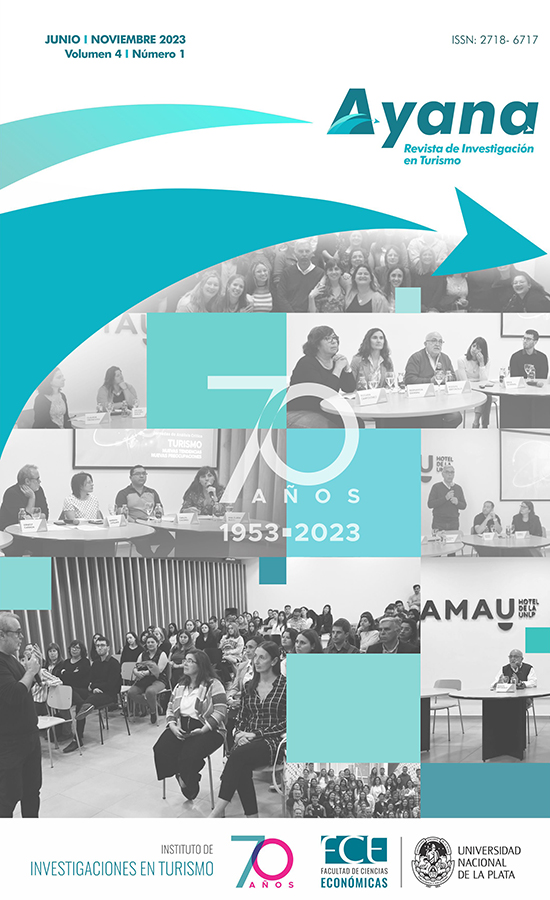
Period December 2023 - May 2024. This number begins the fourth volume of "Ayana. Journal of Tourism Research", presenting two sections: one refers to the debates and reflections on tourism policy, heritage and new trends, which took place in the framework of the Conference on "Critical Analysis in Tourism: New Trends, New Concerns" organised by the Tourism Research Institute (Faculty of Economic Sciences, National University of La Plata), the Tourism and Territory Group (Faculty of Philosophy and Literature, University of Buenos Aires) and Alba Sud (Centre for Research and Communication for Development, based in Barcelona), in October 2022. The other section collects contributions from different parts of Argentina and Mexico, on topics related to studies of the conceptions and behaviour of social actors on the tourist territory.
-
Vol. 3 No. 2
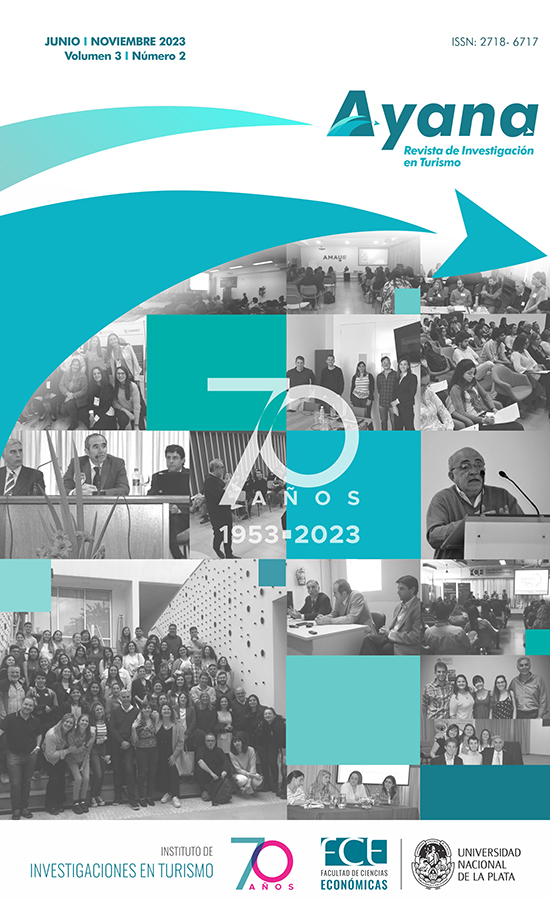
With the current issue ends the third year of the journal. This is part of the celebration of the 70th anniversary of the Faculty of Economic Sciences of the National University of La Plata. Collaborations are presented from universities and research centers from Argentina, Mexico and Spain, which have addressed the study of tourism with special attention to the effects of the COVID-19 pandemic, and processes on territories and their social actors.
-
Vol. 3 No. 1 (2022)
Period December 2022 - May 2023. This issue begins the third volume of "Ayana. Tourism Research Magazine". This issue presents collaborations from universities and research centers in Argentina, Ecuador, Mexico and Uruguay, which cover a diversity of topics related to different aspects of tourism: community tourism and marketing processes, migration and residence, quality measurements, the satisfaction of customers, ecotourism and trust and tourism clusters.
-
 Vol. 2 No. 2 (2022)
Period June 2022 - November 2022 | Tourism, management and social impacts. With this issue ends the second year of "Ayana. Revista de Investigación en Turismo". A series of debates related to scientific tourism problems such us heritage management, tourism marketing, territorial impacts, tourism intelligence and proximity tourism, mainly in Argentina and Mexico, are available in it.
-
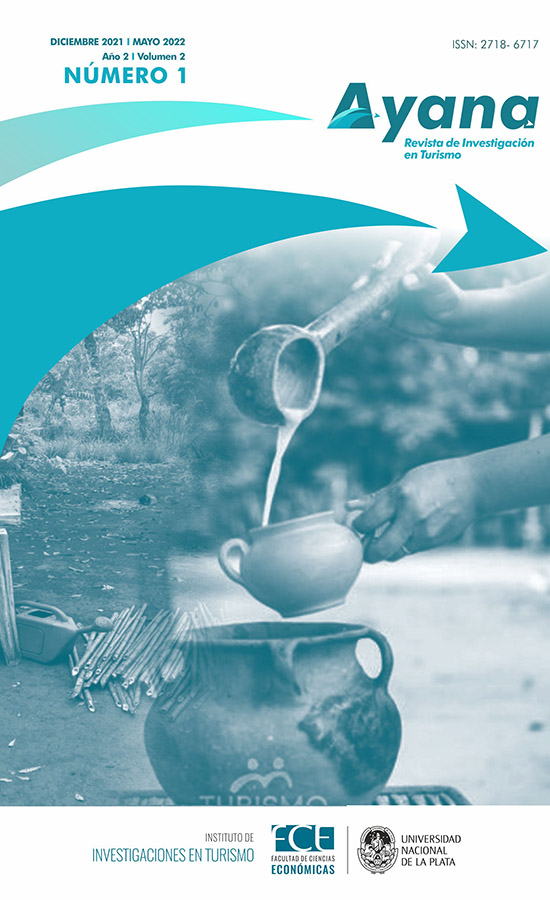
Tourism, communities and rurality
Vol. 2 No. 1 (2021)Period December 2021 - May 2022 | Tourism, communities and rurality. This issue, which presents some of the works exhibited in the First Workshop “Turismo, Comunidades y Ruralidad. Debates y construcción de sentidos desde los territorios” held in May 2021, invites us to move towards rural contexts on the margins to investigate the role of local communities in the planning and development of tourist endeavors in these contexts. The contributions of this issue analyze community tourism processes in different regions of our country (Province of Buenos Aires, AMBA, Misiones, Jujuy, Catamarca), and of other countries such as Mexico and Paraguay, providing a broad panorama of the debates around these processes.
-
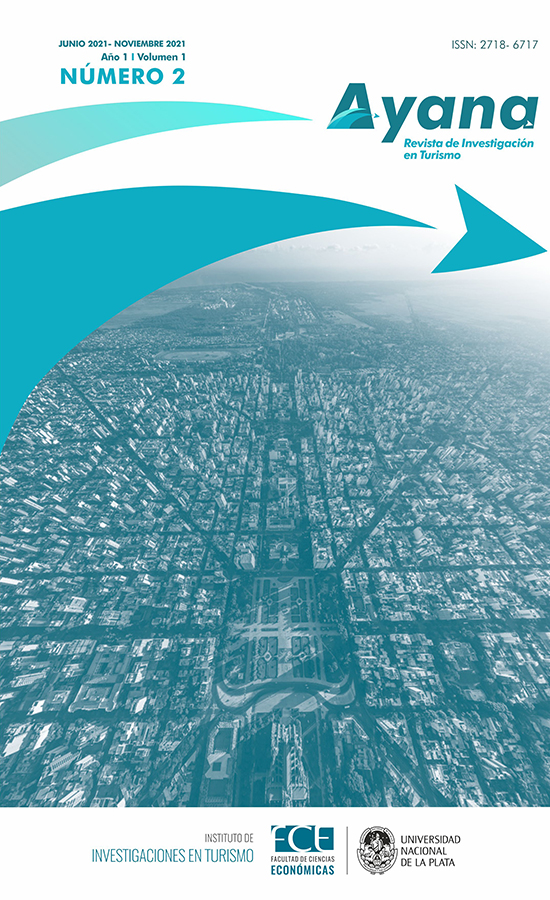
Tourism in motion
Vol. 1 No. 2 (2021)Period June 2021 - November 2021 | Tourism in motion: Ayana means transit. And that movement is the one that continues with the second number of the journal in a complex context for tourism and academic activity. This is a journal number that will expand the scope and previous contributions related to Brazil, Argentina and Spain. In it, as in each work, reflections are raised on various topics with the challenge of reflecting and learning from them.
-
Tourism in motion
Vol. 1 No. 1 (2020)Period December 2020 - May 2021 | Tourism in motion. Ayana means transit. And that movement is the one that we started with this first number of the journal. In a complex context for the tourism activity and for academic activity, this journal number allows us to go from our country to others who honor us with their contributions (Brazil, Spain, United States, Mexico), from the epistemological reflections and academic analyzes to the research questions and inquiries in different areas of professional development. Today, we have taken this first step in the company of people with a great academic career, professionals with great commitment and young students who encourage us to continue in this transit. Considering the challenges in this new pathway, analyzing them and trying to learn from them."
-
Online First
Online First
In Ayana, we seek that scientific knowledge related to tourism is disseminated and open access. In this sense, visibility is a central aspect.
Therefore, the papers sent to the journal, once evaluated and approved, will be available on the website of Ayana, even before they are included in the corresponding issue. Thus, they can be consulted and shared easier and faster.
Below you can find the works of the next issues: